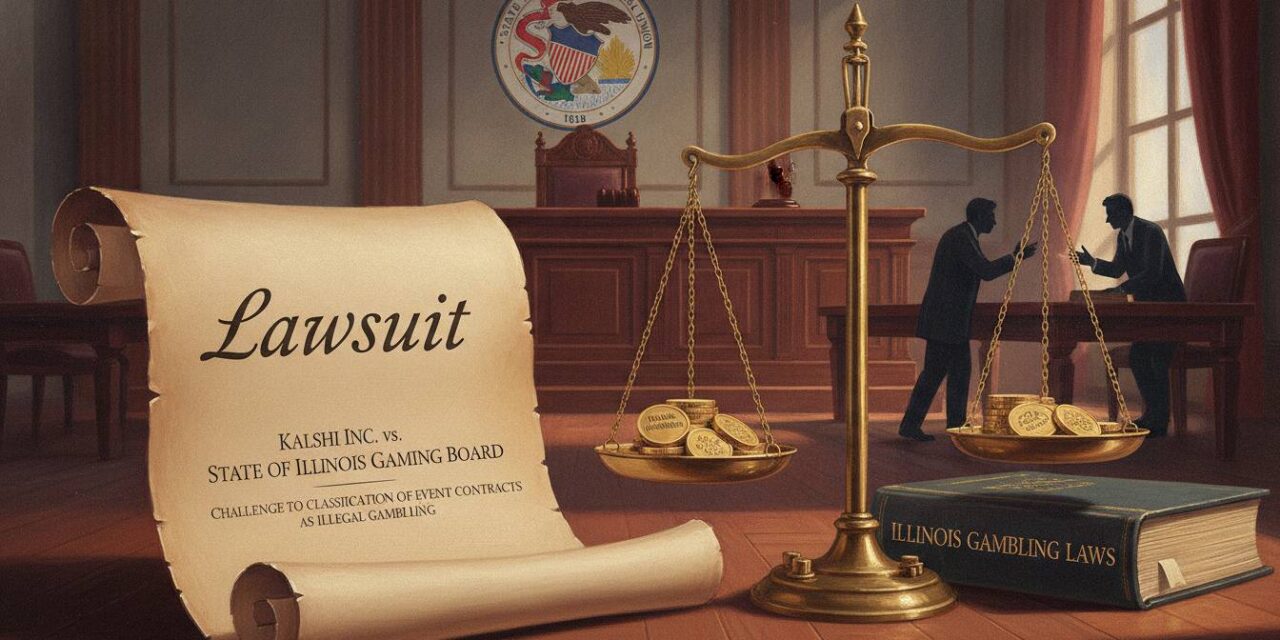
Kalshi, a leading prediction market platform, filed a federal lawsuit this June that challenges Illinois’ new 15% tax on gross receipts. This tax specifically targets sports-related wagers starting July 1, hitting the fast-growing sports betting sector, as Yahoo Finance reports. The complaint claims the tax invades federal regulatory powers and sparks a legal fight over jurisdiction with federal authorities. Illinois created the tax to boost its $55.9 billion budget, CBS News confirmed.
Kalshi is fundamentally different from state-regulated sportsbooks and casinos, according to Capitolnewsillinois’ report.
A preliminary injunction is necessary to restore the federal-state balance that the Constitution mandates, according to Yahoo Finance.
Legal Challenge to Illinois’ New Sports Wagering Tax
A lawsuit filed in the Northern District of Illinois opposes the 15% tax on sports wagers. Courthousenews reports this tax applies directly to wagers on Kalshi’s platform. The suit argues Illinois Gaming Board’s licensing and tax rules breach the supremacy clause because they undercut the Commodity Futures Trading Commission’s (CFTC) exclusive market control.
The 15% tax specifically focuses on gross receipts from sports prediction markets. Kalshi is seeking a preliminary injunction to block the tax’s July 1 start date, and CBS News notes this move aims to restore the federal-state balance under the Constitution.
The Trump administration is suing the State of Illinois to stop it from applying its gambling laws to prediction markets such as Kalshi or Polymarket.View on X
Tax Rates and Licensing Fees Set by Illinois
Illinois created a two-level tax system for prediction markets, NPR Illinois details. The base tax is 1.75% for the first 5 million wagers each fiscal year, rising to 3.5% for all wagers beyond that. Plus, a 15% tax applies to gross receipts from sports prediction markets. This setup aims to capture revenue from bets that Kalshi and others handle. The Illinois Gaming Board established a $15 million initial licensing fee for operators, with renewal fees of $1 million every four years, CBS News reports.
These fees directly support the state’s sizable fiscal budget of $55.9 billion.
Under the Trump administration, the CFTC asserted sole federal oversight of prediction markets and recently sued Illinois and others over regulatory overreach, according to Capitolnewsillinois’ report.
Federal vs State Regulatory Conflict
The battle for prediction market control is heating up between federal and state authorities. The CFTC views prediction markets as falling under federal law. They’re treated as derivatives or futures contracts under the Commodity Exchange Act.
LATEST: ⚖️ Kalshi sued Illinois and Governor JB Pritzker over a new state law requiring prediction market platforms to get a state license, saying the requirements are preempted by federal law.View on X
The CFTC argues that Illinois’ tax disrupts the federal regulatory system it oversees. Kalshi maintains prediction markets operate within a federal framework designed for transparency and risk control. The lawsuit claims Illinois’ actions disrupt uniform oversight and create legal uncertainty.
Chicago Suntimes reports industry supporters see Kalshi as fundamentally different from state-licensed sportsbooks.
Legal Implications
This lawsuit arrives amid growing interest in sports prediction markets, which blend betting with real-time event forecasting. Several states, including Illinois, are exploring new ways to raise sports betting revenue, but conflicting regulatory rules risk creating uncertainty for these markets. If upheld, the 15% tax on Kalshi’s revenues could set a nationwide precedent encouraging similar levies elsewhere, along with posing risks of prolonged litigation and operational disruptions for operators.
Future Outlook and Industry Reactions
This legal fight in Illinois creates major uncertainty for operators, lawmakers, and investors. The July 1 tax start may shift based on court rulings on Kalshi’s injunction. Sportsbettingdime reports that Kalshi and other platforms like Crypto.com and Robinhood received cease-and-desist letters from the Illinois Gaming Board in April 2025, highlighting rising regulatory pressure on the industry.
On Google, tick the box next to stnews.live to see our reporting higher in Top Stories.
Disclaimer: The content on this page is for informational purposes only and does not constitute financial advice. Always do your own research before making investment decisions.

Elena Petrova is a regulatory correspondent specializing in crypto law and policy with over 10 years of financial journalism experience. Formerly a finance reporter at Reuters, Elena covers SEC enforcement, MiCA implementation, and global stablecoin regulations. She holds a J.D. from Georgetown Law and is a member of the New York State Bar. Her regulatory analysis is frequently referenced by compliance officers and legal teams at major exchanges.
Conflicts of interest
I have no current legal practice or retainer relationships with any cryptocurrency company. Past employment relationships are listed publicly.