This article is for informational purposes only and does not constitute financial or investment advice. Cryptocurrency markets are highly volatile. Always do your own research before making any investment decisions.
Standard Chartered say Bitcoin found its cycle bottom at $59,000 on June 5, coming right after a sharp drop from the October 2025 high. Their latest research sets a $100,000 year-end BTC target based on three main signs: steady buying by corporate treasuries (especially MicroStrategy), strong inflow into spot Bitcoin ETFs, and the impact of Monday strategy news from major digital asset companies. These signals—together—bolster StanChart’s view on Bitcoin’s recovery after a huge 53% slide.
Kucoin attributes Standard Chartered’s Bitcoin bottom checklist to three key points: the timing of the market bottom now aligns with large-scale corporate buying. MicroStrategy, for example, held 845,256 BTC as of June 8, putting it front and center.
This huge holding, which dwarfs other public companies, drives StanChart’s conviction in a corporate-led demand floor. Kucoin also reports that flows into spot Bitcoin ETFs have stayed positive through most price drops.
Standard Chartered link ETF resilience during the latest decline to rising institutional faith, helping shape the $59,000 “macro bottom.” The volume spike traders noted signals more big players entering during this dip—unlike typical retail-driven panics.
Numbers Behind the $100,000 Target
Kucoin ties Standard Chartered’s $100,000 price goal for 2026 to observed market flows, as detailed in their research.
The bank’s researchers argue that regulated ETF demand and persistent treasury buying form a price floor that just didn’t exist in earlier Bitcoin cycles. If Bitcoin drops under $59,000, the entire thesis could unravel and would have to be reviewed immediately.
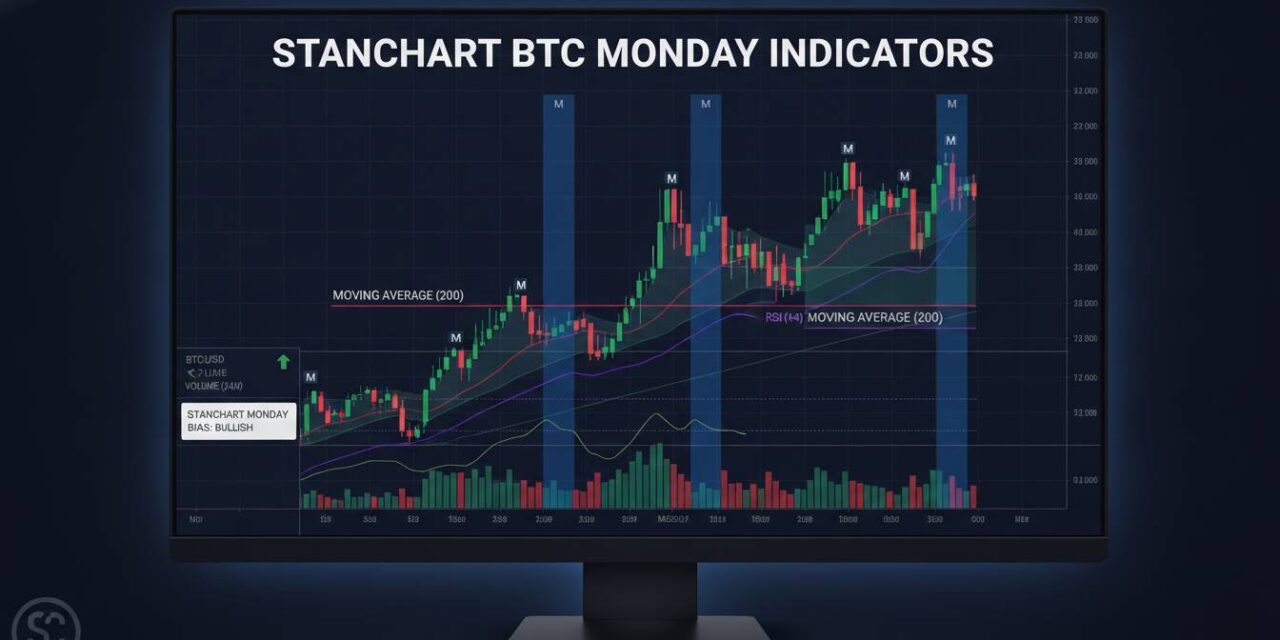
Following StanChart’s report, TradingView’s BTCUSD chart showed Bitcoin stabilizing a little above $59,000. Traders are treating the bank’s call as an important turning point. As of June 8, continuous treasury buying and steady ETF flows demonstrated investors still want exposure to risk. That $100,000 price target, built on these relentless flows, looks more credible as long as the trends hold.
Bitcoin tumbles after Strategy sale unnerves crypto traders https://t.co/iOzjQ3Cg1eView on X
MicroStrategy and Corporate Demand
Relentless Bitcoin accumulation by MicroStrategy remains central to Standard Chartered’s cycle-bottom argument. Kucoin details the company’s holding as of June 8, 2026: 845,256 coins, making it the biggest public corporate BTC holder by a wide margin.
Role of Spot Bitcoin ETFs and Institutional Flows
Spot Bitcoin ETF resilience is crucial to Standard Chartered’s thesis. ETF inflows stayed positive from October 2025 through June 2026, even with steady declines in price.
Data from Tradingview demonstrates that ETF-driven trading volume often spikes right after Monday news, particularly following treasury or balance-sheet reports. Since January 2026, more than $10 billion has entered ETFs through regulated channels—anchoring the spot price and flattening typical wild swings.
Strategy the Monday Effect
The Monday “strategy news” effect serves as the third pillar of Standard Chartered’s bottom checklist, per Kucoin.
Recent cycles have seen Monday news from both software firms and ETF managers cause sharp moves or establish fresh support levels. After every major Monday announcement, a direct bounce usually follows—reinforcing StanChart’s thesis on the power of coordinated calendar events in marking BTC cycle bottoms.
Historical Comparison: 2026 Cycle Versus Prior Winter Bottoms
Looking at history, Kucoin sees a major shift from past “winter” lows. Previous bottoms appeared only after waves of forced retail selling and chaotic unwindings. This $59,000 cycle low, which emerged in a climate of rising institutional demand, clearly stands apart from the panic years.
The market’s structure—anchored by regulated ETFs and disciplined treasuries—has matured significantly compared to the extended drawdowns that followed the 2018 and 2022 cycles.
Risks to the Bottom and Metrics to Watch
However, some at Standard Chartered, drawing from Kucoin and Tradingview data, caution that any fall below $59,000 would force a serious rethink of their bullish perspective. ETF markets can react quickly to negative headlines or thin liquidity—underscoring the need for active vigilance.
Investors now monitor 7-day ETF flows, key corporate reporting days, and on-chain outflows. Tradingview makes clear that rising prices with higher volumes would fit the recovery script. On the flip side, if Bitcoin drops under $59,000 on major volume, the “bottom” may truly be lost. The link between Monday news events and on-chain supply remains in sharp focus.
Implications for Investor Positioning and Future Catalysts
Moving through this cycle, patience and careful sizing are what matter most, according to Kucoin’s summary of the StanChart playbook. The “cycle low” checklist now lets institutional players build positions, using $59,000 as their anchor point.
Upcoming events may shift the price outlook—policy updates, treasury filings, and on-chain holding changes are all in play. Should ETF flows break new records, or more treasuries confirm fresh purchases after a Monday strategy announcement, that $100,000 target isn’t out of reach for Q4 2026.
On Google, tick the box next to stnews.live to see our reporting higher in Top Stories.
Disclaimer: The content on this page is for informational purposes only and does not constitute financial advice. Always do your own research before making investment decisions.

Elena Petrova is a regulatory correspondent specializing in crypto law and policy with over 10 years of financial journalism experience. Formerly a finance reporter at Reuters, Elena covers SEC enforcement, MiCA implementation, and global stablecoin regulations. She holds a J.D. from Georgetown Law and is a member of the New York State Bar. Her regulatory analysis is frequently referenced by compliance officers and legal teams at major exchanges.
Conflicts of interest
I have no current legal practice or retainer relationships with any cryptocurrency company. Past employment relationships are listed publicly.