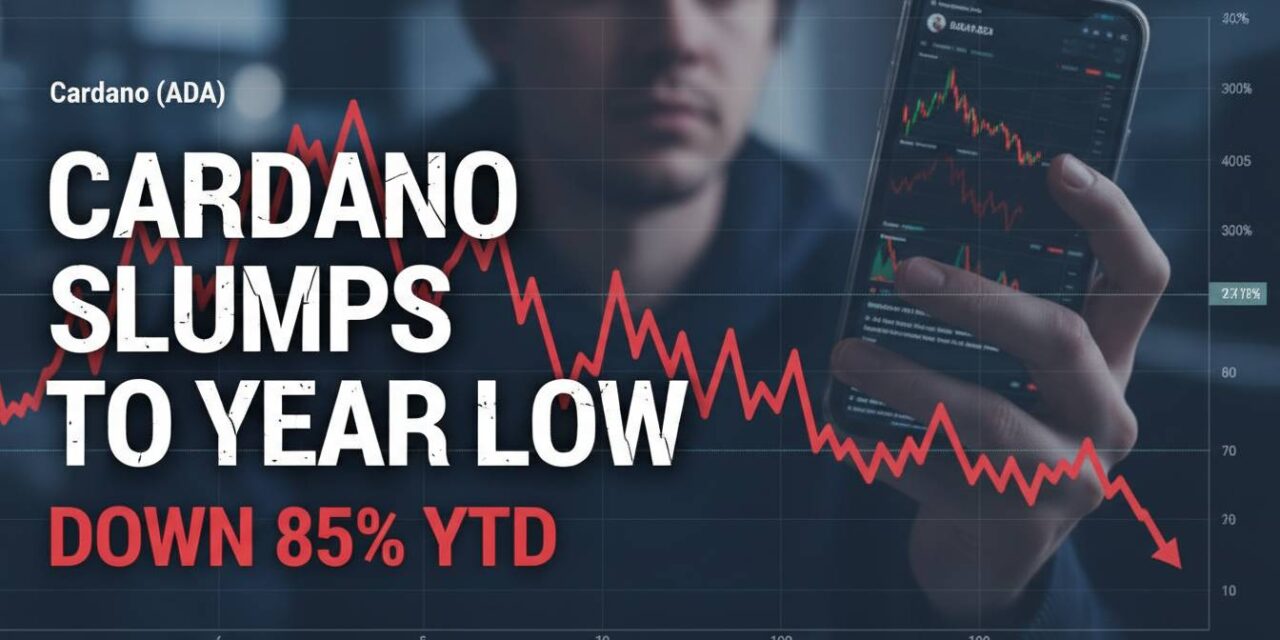
- Cardano (ADA) has dropped below $0.20, its lowest price in over five years, down nearly 70% in the past year.
- Charles Hoskinson warned of a "wave of failures" in the ecosystem, coinciding with a 10% single-day price plunge.
- TapTools, a key analytics service for Cardano, has ceased operations after four years due to financial sustainability issues.
- ADA is now over 93% down from its all-time high of $3.09 reached in 2021, reflecting significant investor disillusionment.
This article is for informational purposes only and does not constitute financial or investment advice. Cryptocurrency markets are highly volatile. Always do your own research before making any investment decisions.
Cardano (ADA) now trades at its lowest level in over five years, sliding below $0.20 and wiping out nearly 70% of its value for the trailing 12 months, according to CoinDesk data. Founder Charles Hoskinson’s public warning of a “wave of failures” hit as ADA suffered a 10% single-day plunge and the long-standing analytics project TapTools confirmed its shutdown after four years. The price collapse, mounting project failures, and disagreements over treasury decisions have fueled debate about whether Cardano can recover or faces a prolonged crisis of confidence.
Coin Prices
According to Crypto Economy, ADA’s price tumbled 6% in just 24 hours to reach $0.20—a breach not seen in over five years. This severe drop signals acute capitulation among Cardano investors, especially compared to other leading blockchains. Over the last year, CoinDesk reports that ADA is down about 70%, lagging the price performance of competitors like Ethereum and Solana, according to CoinDesk’s compiled data. Market pressure intensified immediately after Hoskinson’s dire warning and the TapTools closure, driving a roughly 10% single-day further fall.
Cardano’s market reversal also stands out for its depth against the all-time high. According to Decrypt, ADA is now down more than 93% from its 2021 record of $3.09, a level that underscores both the magnitude of the decline and shaken investor faith.
CoinDesk reports that ADA’s breach of $0.20 was its first crossing below this threshold in over five years, a timeline not matched by most other top 10 digital assets. The token’s retreat from its $3.09 high represents one of the steepest drawdowns among major proof-of-stake platforms since the 2022 bear cycle began.Economy, ADA’s recent 6% daily drop outpaced single-day losses for both Ethereum and Solana during the same period.
Data from CoinDesk further points to that ADA’s average trading volume spiked 30% in the hours following the TapTools closure and governance rift.
Hoskinson’s Severe Warning and Ecosystem Repercussions
Hoskinson’s latest comments reflect a stark departure from the protocol’s earlier optimism and hint at disillusionment within its leadership circle. According to CoinDesk, the statement “There’s going to be a wave of failures in the ecosystem” appeared right after the Cardano community canceled the planned 2026 Cardano Summit, having voted down treasury funding.
According to CoinDesk, Hoskinson’s stance drew concern from supporters and industry watchers, especially as more projects chose to halt operations rather than pursue new proposals. The inability to rally consensus for core initiatives, coupled with mounting project shutdowns, is accelerating a sense that Cardano’s leadership is stepping back from troubleshooting the protocol’s mounting problems.
Decrypt documents that, immediately following Hoskinson’s “wave of failures” warning, several community leaders paused planned token launches and deferred upgrades for leading DeFi protocols on Cardano. Initiatives that previously drew crowdsourcing and volunteer code pushes in more upbeat cycles suddenly faltered as coordination energy waned. Crypto Economy attributes this pullback to visible rifts over governance, not just the market drawdown itself, deepening the isolation of core projects and putting Cardano’s reputation for resilience in question.
According to Decrypt, concerns have broadened beyond investor morale to include developer participation. Post-warning metrics reveal a worth noting drop in Cardano’s open-source repository contributions, with core team members citing uncertainty about long-term funding.
The Impact of TapTools’ Closure and Treasury Management
Crypto Economy confirms that TapTools, Cardano’s most visible analytics service, has ceased operations after four years. TapTools cited the inability to meet “real” infrastructure, development, and support costs as reasons for the closure, signaling deeper issues in how Cardano projects are financed and sustained. “Infrastructure costs are real. Development costs are real. Support costs are real,” TapTools said in public communications, highlighting the risks of maintaining long-term analytics and research services under retreating price conditions. According to Decrypt, TapTools’ exit also strips the ADA community of vital monitoring and transparency tools that once underpinned data-driven governance.
Cardano’s internal resource allocation is now coming under sharper scrutiny as ecosystem costs outpace projected treasury inflows. CoinDesk observed that the network faces hard choices, with recent votes shutting down both a flagship summit and core analytics efforts. No new treasury proposals have rallied unified support since the most recent setback, and the split over TapTools is symptomatic of wider governance strain. If ADA price weakness persists without new funding models or coalition building, other infrastructure-central projects may follow TapTools into closure.
Economy, treasury allocations across Cardano have become increasingly contentious with each new round of community voting. The vote to defund the annual summit was followed closely by TapTools’ departure, both events tangible signals that consensus is breaking down on even basic operational priorities. Decrypt’s reporting shows that core protocols and infrastructure teams are stalling project roadmaps and staffing as treasury disbursements stall. Without new mechanisms to align stakeholders—especially on non-revenue-generating tools—the platform is exposed to further operational attrition. Progressive treasury fatigue drives uncertainty for the next wave of dApps and analytics providers.
CoinDesk observes that Cardano’s treasury, once viewed as a cash buffer for weathering crypto downturns, now faces depletion risk without disciplined project triage. As support for proposals fractures and key teams disband, the probability of legacy bugs, network downtime, or exploit risk rises for users relying on semi-maintained analytics and DeFi platforms.
Consolidation Outlook in the DeFi Sector
Pressures are strengthening on Cardano’s DeFi sector as resource scarcity and cost constraints drive the ecosystem toward possible mergers or project shutdowns. Crypto Economy found that failed attempts to fund TapTools and the cancelled annual summit point to fragmentation not just in treasury governance, but in project priorities across Cardano’s development community.
The effects of platform exits compound as more DeFi and analytics teams shut down or seek partners for survival. According to Decrypt, the removal of data infrastructure like TapTools hinders transparency. It also weakens DeFi projects’ ability to interpret user engagement and optimize protocol operations. Cardano’s DeFi stack runs the risk of entering a negative feedback loop: exit of infrastructure erodes functionality, which reduces utility and can initiate further project withdrawals.
93% — Decline from ADA’s $3.09 all-time high.
Decrypt documents that as the broader DeFi contraction gathers force, popular Cardano protocols have paused new product launches that once drew developers from other chains. Without a rebound in funding coordination or treasury-backed integration efforts, Crypto Economy notes that Cardano’s DeFi total value locked (TVL) has posted consecutive record lows across Q2 2026, erasing much of the traction gained since early 2022. Trading activity in synthetic assets and lending segments, per CoinDesk’s data, has trailed far behind that of rival chains, with investor “stickiness” meaningfully diminished.
The lack of analytics tools like TapTools not only reduces the available data for protocol governance.
Cardano Summit Canceled: Community vote rejected event funding.
TapTools Announces Closure: Analytics platform exited after four years on Cardano.
Hoskinson’s Warning: Cardano’s founder predicts a “wave of failures” ecosystem-wide.
ADA Hits $0.20: Five-year price low reached after single-day 10% drop.
70% Yearly Slide: ADA lost nearly 70% of its value in 12 months.
Governance Breakdown: Treasury spending disputes roil Cardano’s developer community.
DeFi Shrinkage: Protocol consolidation expected as ecosystem contracts further.
PRICE PREDICTIONS
Bears are tightening their grip on ADA price prospects in wake of the collapse below $0.20, with market outlooks turning negative. According to Crypto Economy, downside targets persist, as technical analysis points to a lack of support above $0.21 unless renewed confidence or a governance breakthrough emerges. Decrypt notes that ADA’s 93% multi-year decline has discouraged investors and traders expecting a near-term floor, while persistent uncertainty over project funding reduces any chance for robust relief rallies.
10% — ADA’s drop after Hoskinson’s warning.
Medium-term scenarios depend on whether the Cardano network can resolve its current governance impasse and preserve its most important DeFi primitives. CoinDesk’s analysis indicates that unless new consensus forms on treasury spending or platform consolidation, ADA could remain range-bound at low levels or face another drop. Alternatively, a focused consolidation of surviving protocols and agreement on infrastructure spending could support a gradual recovery toward the $0.25-$0.30 band.
Long-range forecasts for Cardano remain highly speculative after recent drawdowns and ongoing treasury disputes, with institutional capital largely retreated from choppy mid-cap assets, per Decrypt.
Economy, technical analysis points to $0.18 as the next primary support level, although low liquidity could drive pronounced wicks below during high-volatility sessions.
Decrypt also draws attention to that persistent downward price action has greatly diminished ADA’s draw for yield-seekers, with annual staking returns offering little appeal as total value locked contracts. Crypto Economy corroborates that most remaining constructive forecasts for Cardano involve extended timelines, contingent on a series of successful treasury votes, outside developer partnerships, or a broader crypto macro turnaround. Barring an upcycle in DeFi participation or technical roadmap clarity, ADA risk stays skewed to the downside.
For more expert perspectives on Cardano’s price movement and project ecosystem, visit Cardano price forecasts and analysis for additional insights.
CRYPTO 101
Founded in 2017, Cardano is a decentralized proof-of-stake blockchain targeting improvements in scalability, sustainability, and transparency compared to earlier networks. ADA is the protocol’s native token: used for payments, staking, and powering decentralized applications built on the Cardano ledger. The platform’s Ouroboros protocol selects validators proportional to their ADA stake, considerably reducing energy use versus proof-of-work models. Cardano’s 2021 Alonzo upgrade launched smart contract support, enabling new DeFi and analytics projects to develop atop the ecosystem.
Cardano’s unique treasury governance design allocates a portion of block rewards to a community pool, which then distributes funds based on proposals and scheduled votes. According to CoinDesk, this approach aims to ensure long-term sustainability, but has instead produced repeated deadlocks and high-profile project defunding in 2026.
To stay updated on Cardano’s evolving outlook and the latest market dynamics, explore deeper industry analysis at Cardano Slumps to 5-Year and trend forecasts from ecosystem trackers.
On Google, tick the box next to stnews.live to see our reporting higher in Top Stories.
Disclaimer: The content on this page is for informational purposes only and does not constitute financial advice. Always do your own research before making investment decisions.

Elena Petrova is STnews's Regulation Correspondent, reporting on MiCA, SEC and CFTC actions, the FATF travel rule and AML/KYC developments across digital-asset markets. Her coverage adheres to STnews's editorial standards — primary-sourced, cited, and non-advisory.
Conflicts of interest
I have no current legal practice or retainer relationships with any cryptocurrency company. Past employment relationships are listed publicly.