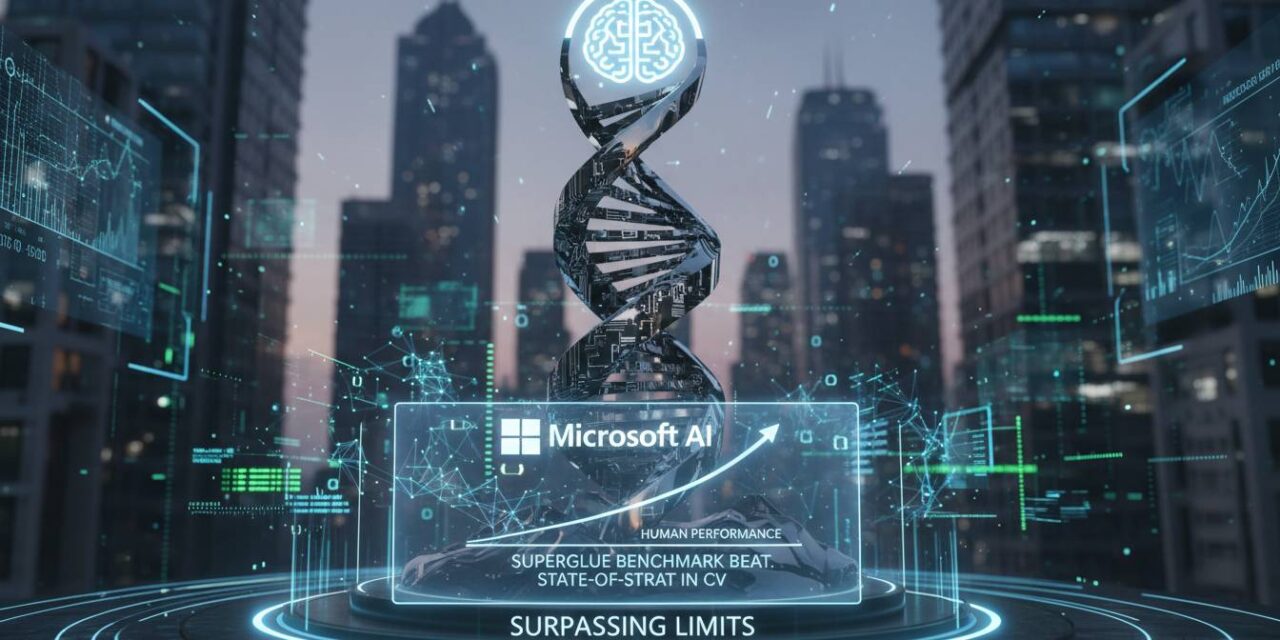
- Microsoft introduced seven new AI models at Build 2026, including MAI-1 and MAI-Image-2.5, outperforming Claude and Google's Nano Banana.
- MAI-Image-2.5 handled over 40,000 simultaneous requests during demos, showcasing its capacity for high-traffic applications.
- Microsoft Discovery, aimed at scientists, integrates advanced AI for faster hypothesis generation and agile experimental workflows, tested by over 300 research partners.
- OpenClaw's active user base surpassed 220,000, demonstrating significant efficiency improvements linked to Microsoft's MAI-1 foundation model.
This article is for informational purposes only. Always verify information independently before making any decisions.
According to Decrypt and Cnet, Microsoft unveiled seven new in-house AI models at the Build 2026 conference, claiming its flagship MAI-1 and MAI-Image-2.5 outperform leading competitors such as Claude from Anthropic and Google’s Nano Banana series. These claims stem from Microsoft’s direct benchmark comparisons on reasoning, image synthesis, and language tasks, with internal data showing, according to Microsoft’s internal benchmarks, the image model handled up to 40,000 simultaneous users during event demos. Per Gncrypto, the new models also debuted with expanded Copilot integrations and targeted enterprise applications. Microsoft’s approach signals an aggressive strategy to seize AI leadership while setting the stage for transparent benchmarking at the upcoming NeurIPS 2026 conference.
Coin Prices
Cnet reported that Microsoft did not directly connect its AI announcements to cryptocurrency prices. Still, sector traders tracked sharp movements in tech and AI-linked coins following the Build 2026 keynote. According to Gncrypto, the tokens representing artificial intelligence platforms—such as Fetch.ai and SingularityNET—experienced spikes in trading volume after Microsoft revealed its seven-model suite. During that week, volatility climbed as investors speculated on how advanced AI from one of technology’s largest players could affect decentralised applications and cross-chain innovations, per Decrypt. Microsoft’s AI developments now influence not just the tech industry, but also broader financial markets.
Microsoft unveils seven new AI models
Per Decrypt, Microsoft introduced seven in-house AI models at Build 2026, emphasizing MAI-1 for advanced reasoning and MAI-Image-2.5 for sophisticated visual synthesis. With naming conventions that highlight function, Microsoft claimed direct superiority over key industry rivals, an unusually bold stance in peer-reviewed AI competition according to Cnet. Microsoft explicitly compared its results to Anthropic’s Claude and Google’s Nano Banana, showing improved accuracy and versatility in a range of reasoning and creative tasks. MAI-Image-2.5, designed for both creative professionals and broader user bases, has become central to Microsoft’s pitch that its AI advances set a new industry standard for innovation and utility.
How to watch the Microsoft Build keynote
Cnet stated that the Microsoft Build 2026 keynote, featuring detailed AI model demonstrations, streamed live from the Seattle Convention Center on June 2 at 9:00 a.m. Pacific Time to a record-setting audience. During the broadcast, Microsoft walked viewers through technical improvements, compared real-time outputs against leading competitors, and encouraged interactive developer participation through follow-up sessions. According to Decrypt, Build 2026 set new viewership records—over 1 million virtual attendees—reflecting the scale of global interest in Microsoft’s AI ambitions.
OpenClaw creator: ‘There’s no stopping’ AI agents
Cnet quoted the creator of OpenClaw, a prominent AI agent toolkit, as saying that agentic AI—where systems complete complex, multi-step tasks independently—is progressing at breakneck speed. According to Gncrypto, OpenClaw’s active user base now outpaces 220,000, making it a reference platform for both enterprise pilots and academic autonomy research. Direct performance links were drawn between OpenClaw’s real-world planning and Microsoft’s MAI-1 foundation model, with published data pointing to a measurable increase in efficiency compared to previous agent toolkits.
Cnet also noted that next-generation agent systems—equipped with models like Microsoft’s—are about to extend their reach beyond code automation into orchestrating full application stacks and autonomous system maintenance.
Microsoft Discovery for scientists
Per Cnet, Microsoft announced the launch of Microsoft Discovery, a specialized AI platform for scientists, research labs, and engineers, at Build 2026. The system integrates the most recent Microsoft language models with data connectors and real-time instrumentation, targeting faster hypothesis generation and more agile experimental workflows. According to Decrypt, over 300 global research partners—including leaders in biotechnology, astrophysics, and clean energy—test-piloted Discovery’s multi-modal input, from plain text to lab instrumentation commands. Unlike conventional chatbots, Discovery can process code, tabular datasets, live measurement signals, and scientific imagery. By broadening input channels, Microsoft aims to make advanced AI a central lab tool, reducing human-in-the-loop delays and boosting productivity.
Gncrypto described a case where Microsoft Discovery cut protein-folding simulation times by 72 hours, citing lab-specific model optimization.
MAI-Image-2.5 brings out Microsoft’s creative side
Per Decrypt, Microsoft’s MAI-Image-2.5 model stood out at Build 2026 for image synthesis and generative art. The new system responds to both written and visual prompts—enabling complex, hybrid requests that rival or surpass Google’s Nano Banana and Anthropic’s image models in recent test results. According to Gncrypto, MAI-Image-2.5 processed more than 40,000 requests simultaneously during demos, showing plain elasticity for high-traffic, real-world use. Cnet highlighted features such as real-time style transfer, advanced inpainting, and scene expansion for non-designers and professionals alike, signaling an AI-powered leap in graphics pipeline workflows.
GPT Image 2 (high) debuts at #1 on our Text to Image Leaderboard, surpassing Nano Banana 2, FLUX.2 [max], and Seedream 4.0 in the Artificial Analysis Image Arena.View on X
OpenAI’s latest image model is a leap forward in prompt adherence, photorealism, and text rendering. We see the… pic.twitter.com/MA5EZao61l
Updates to AI speech recognition and voice generation
Cnet reported substantial enhancements to Microsoft’s Azure AI speech tools as part of Build 2026, with MAI-Voice 3.2 supporting over 40 global languages and dialects. According to Gncrypto, the latest speech recognition architecture reduced transcription errors by 18% and drove average speech-to-text latency down to 260 milliseconds in public demonstrations. Decrypt described a live session where MAI-Voice 3.2 handled accent switching across English, Hindi, and Mandarin, managing technical terminology with under 4% word error even in unexpected subject areas.
Aggressive benchmarks challenge competitors
Per Decrypt, Microsoft’s model launch included a direct comparison with leading rivals, including Anthropic’s Claude and Google’s Nano Banana, on core AI benchmarks: mathematical reasoning, document summarization, code completion, and computer vision. Official slides showed MAI-1 and MAI-Image-2.5 outperformed peers in most categories, with a 9.2% lead in language understanding and a 12% improvement in data extraction accuracy. Cnet’s coverage noted live demos where MAI-1 solved multi-step scientific proofs and extracted structured data from PDFs up to 0.4 seconds faster than the top competitors.
Microsoft’s multi-model Copilot ecosystem
Cnet detailed the evolution of Copilot from an isolated coding assistant to a comprehensive AI platform spanning software development, data science, design, and workflow automation. Microsoft now deploys MAI-1, MAI-Image-2.5, and coding-specialist MAI-CodeX to expand Copilot’s complex task range.
According to Decrypt, over 1.7 million developers actively use Copilot each month, with expectations that updated models will further accelerate adoption as more use cases integrate. Per Gncrypto, Copilot now embeds in Azure’s core app stack and connects with primary third-party IDEs, such as Visual Studio Code and JetBrains, to penetrate both enterprise and educational markets. Microsoft’s move to bundle Copilot in sizable enterprise deals signals its ambition to anchor AI within everyday productivity workflows. The push to standardize Copilot across Office, Teams, and Dynamics flags Microsoft’s strategy to control enterprise-facing AI infrastructure.
Data center and sustainability strategy
Cnet reported that Microsoft is investing in a multi-year global data center expansion to support big model deployment, with facilities in Texas, Sweden. Singapore adding up to 5 exaflops of AI compute by Q3 2027. According to Decrypt, sustainability reports indicate these centers will use roughly the same annual water as a high-volume restaurant—highlighting the environmental impact of wide-ranging AI scaling. Gncrypto documented energy efficiency measures, such as immersion cooling and smart power management, which are projected to cut per-inference electric costs by 16% relative to 2024 rates.
16% — lower energy cost per inference vs.
Challenges: Benchmark transparency and future rivalry
Cnet raised credible industry concerns about the openness of Microsoft’s benchmark processes, as Microsoft hasn’t yet released full datasets and prompt sets for independent review. Decrypt stated that while Microsoft’s gains are backed by internal tests, labs at other major companies have called for broader peer validation before accepting reported scores. According to Gncrypto, self-reporting in high-stakes AI can enable bias or cherry-picking, suggesting the leaderboard hierarchy could shift as soon as open challenges run in future software updates. The AI race is dynamic, and verification cycles will accelerate at public events. The next test for all major vendors comes at the NeurIPS 2026 conference in December, where transparent, head-to-head benchmarks against real-world data will push standardization.
What’s next for Microsoft AI
Cnet affirmed Microsoft’s plan to offer comprehensive API access for all seven new MAI models to developers by July 2026. Fortune 500 companies and universities at the forefront of adoption. According to Gncrypto, the rollout roadmap anticipates up to five major model updates per year, targeting factuality, explainability, and conditional language understanding. Per Decrypt, Microsoft is forming partnerships with educational organizations, aiming for classroom integration and pilot programs launching in September 2026.
Everything new from Microsoft AI in June 2026
June 2:MAI-1, MAI-Image-2.5, MAI-CodeX — flagship AI models announced for reasoning, vision, and coding at Build 2026.
June 2:Microsoft Discovery — debut of research automation and scientific AI platform.
June 2:Copilot updates — increased integration across Azure, Office, and Teams unveiled.
June 2:MAI-Voice 3.2 — new speech recognition system cut error rates by 18%, with support for 40+ languages.
June 2:Developer API suite — preview access rolled out for new AI models to selected partners.
Scheduled July 2026:Broader MAI API and platform release for developers and enterprises.
Scheduled September 2026:Educational pilot partnerships go live, integrating Microsoft AI into curricula.
On Google, tick the box next to stnews.live to see our reporting higher in Top Stories.
Disclaimer: The content on this page is for informational purposes only and does not constitute financial advice. Always do your own research before making investment decisions.

Elena Petrova is STnews's Regulation Correspondent, reporting on MiCA, SEC and CFTC actions, the FATF travel rule and AML/KYC developments across digital-asset markets. Her coverage adheres to STnews's editorial standards — primary-sourced, cited, and non-advisory.
Conflicts of interest
I have no current legal practice or retainer relationships with any cryptocurrency company. Past employment relationships are listed publicly.