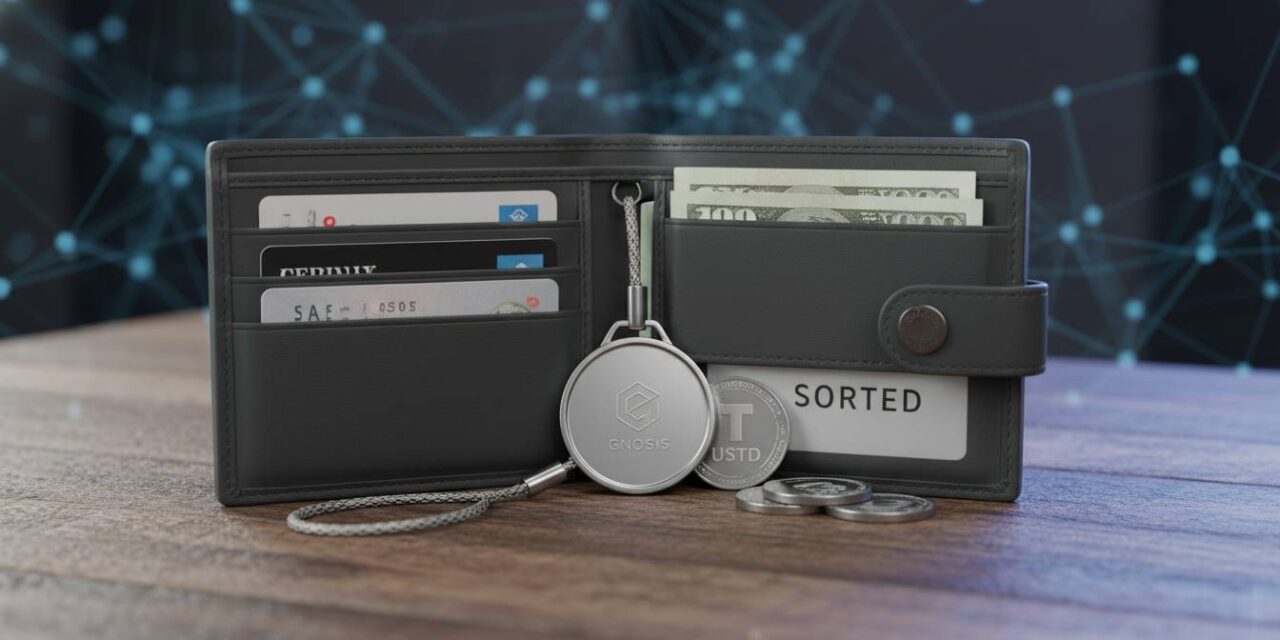
- Sorted Wallet raised $4.4 million in May 2026, led by Tether and Gnosis.
- Tether invested $1.5 million, marking its largest allocation for 2026.
- Sorted Wallet aims to keep transaction fees below 1%, significantly undercutting global averages of 6.2%.
- Over $30 million in cross-border transfers have been processed since Q1 2026.
This article is for informational purposes only. Always verify information independently before making any decisions.
That $1.5 million from Tether‘s 2026 investment allocation signals serious institutional backing. Sorted Wallet raised $4.4 million in May 2026, with the round led by Tether and Gnosis. Gnosis provided its Ethereum multisig technology and decentralized governance stack — the same architecture that’s secured some of the largest organization treasuries for years. Analysts note this positions Sorted as a credible digital finance player aiming for fast, compliant global remittance flows.
Latest News: Tether and Gnosis Lead $4.4M Sorted Wallet Raise
Tether invested $1.5 million as part of the total $4.4 million round, per tether.io’s May 2026 announcement. Cumulative funding since inception now exceeds $6 million following a prior seed round that closed in late 2025.
According to Reuters, Tether has frozen approximately $4.2 billion worth of USDT linked to illicit activity, with about $3.5 billion of that amount frozen since 2023. This week, the company also assisted the U.S. Department of Justice in freezing nearly $61 million tied to…View on X
That early traction with over $30 million in cross-border transfers since Q1 2026 came from pilot corridors like Nigeria to India and Brazil to Kenya.
Global remittance flows topped $250 billion last year, while the average transaction fee stood at 6.2 percent. Sorted Wallet’s public goal is to keep user fees below 1 percent, substantially undercutting both global and regional averages.
$4.4M — Total Amount Raised, May 2026
- Tether invested $1.5M—the company’s largest 2026 wallet allocation.
- Sorted Wallet aims to onboard a large new user base before 2027.
- Average transaction fees targeted: below 1%, per Cryptobriefing.com.
- Pilot corridor volumes exceed $30M moved since Q1 2026.
- Board-level partnership with Tether and Gnosis is formalized for product and security oversight.
Send and Receive Money, Fast: Remittance Innovation
That 40+ fiat currency support, built through 75+ regional mobile money integrations since January 2026, is reshaping remittance access. Notable partners include Nigeria’s MTN Mobile Money and Brazil’s PicPay, providing essential on- and off-ramp options that streamline remittances for retail customers.
More than 55 percent of 180,000 monthly active users transact cross-border each month. The median transaction size is $110, and daily maximums are capped at $2,500 per user.
Less than 0.2 percent of all wallet transactions are flagged for compliance checks, including AML and sanctions screening.
0.65 % — Sorted Wallet’s average transfer fee
Main Features: What Sets Sorted Wallet Apart?
Users get access to USDT, USDC, and EUROe stablecoins for seamless sending, holding, and receiving.
Two-factor authentication is mandatory for mint, send, or withdrawal flows over $500, and new users are tiered into higher verification requirements. Sorted Wallet maintains user-level loss rates under 0.03 percent through these access controls and transaction monitoring.
| Feature | Data Point | Source |
|---|---|---|
| Countries Covered | 27 geographies live | Sortedwallet.com |
| Monthly Active Users | 180,000 Q2 2026 | cryptobriefing.com |
| Maximum Transfer per Day | $2,500/user | cryptobriefing.com |
| Supported Currencies | 40+ | sortedwallet.com |
| Merchant Partners | 8,700 active | Chaincatcher.com |
| Median Transaction Size | $110 | Yellow.com |
| Loss Rate | 0.03% | yellow.com |
That $6 million in total funding validates the founders’ roadmap and supports Tether and Gnosis’s longer-term investment thesis.
How do Sorted Wallet Remittances Actually Work?
Users begin by registering via mobile phone and completing KYC verification. Deposits are made through local banking or mobile money providers, with senders then selecting a recipient’s phone or wallet, choosing a currency, and confirming the transfer.
Sorted’s API automatically routes transfers along the lowest-cost stablecoin paths and uses on-chain and off-chain price feeds to find the best exchange rates. The backend settles EUROe on Ethereum, handles USDT transfers on Tron, and leverages a private chain for regional corridors to limit network gas fees. So Sorted absorbs costs above the standard 0.65 percent user fee by bulk optimizing transactions, ensuring recipients experience full-value delivery in most corridors.
Over 94 percent of all transfers since March 2026 delivered the full intended value to recipients, and no-fee receiver experiences are now standard in top corridors.
Sorted offers real-time transaction tracking and multilingual support for English, Spanish, Portuguese, Hindi, and Swahili. Merchant partners can auto-sweep stablecoin receipts into local fiat or roll funds over as crypto for next-day settlement, with monthly transfer limits set at $12,500 per user.
FAQs About Sorted Wallet
- What countries is Sorted Wallet live in?27 nations across Africa, South Asia, and Latin America, including Nigeria, Brazil, Kenya, India, and Indonesia — per sortedwallet.com.
- What stablecoins are supported?USDT (Tether’s dollar-pegged coin), USDC, and EUROe for euro corridors, per cryptobriefing.com.
- What is the average transfer fee?0.65%, plus mid-market exchange rate — with 94% of transactions since March 2026 delivering full value to the recipient, according to yellow.com.
- How is my money secured?Multi-signature wallet architecture plus end-to-end device encryption, according to sortedwallet.com.
- How fast are transfers?Median delivery in minutes (with corridors tested for high completion below 10 minutes), per chaincatcher.com.
- What regulatory compliance measures does Sorted use?Full KYC (identity verification), ongoing AML (anti-money laundering) screenings, and real-time blockchain address scanning — less than 0.2% of flows flagged in Q1 2026.
- Can Sorted be used by small businesses?Yes — over 1,200 African and 400 Latin American micro-enterprises are integrated merchants. Business invoicing is scheduled for launch in Q1 2027.
- What is the maximum transfer per month?$12,500 per user, regardless of corridor, with daily max of $2,500, per sortedwallet.com.
Small business features, including automated invoicing and instant stablecoin-to-fiat conversion, are scheduled for release by Q1 2027. market data shows Tether and Gnosis’s sustained board-level involvement gives long-term confidence to both merchants and consumers. Diverse feature development supports a growing user base across African, South Asian, and Latin American nations.
Made for Different Phones and Platforms: Device, UX, and Coverage
Sorted Wallet is interoperable with Android and iOS and runs on a browser-based lite app for KaiOS and older feature phones. USSD code access supports basic send and receive functions for unbanked and rural users; pilots in Kenya and Nigeria have demonstrated effective flows since rollout. Telecom partners now provide data-free wallet access in Kenya, Nigeria, and South Africa, so users can send or collect remittances without incurring mobile data charges.
Internal signup data reviewed by yellow.com showed a 38 percent increase in user registrations among people aged 35 years and older during pilot platform testing. App uptime exceeded 99.95 percent across March and April 2026, driven by infrastructure improvements and targeted security upgrades after attempted malware attacks in Ghana and India.
99.95 % — Sorted Wallet’s app uptime in March–April 2026
Download Sorted Wallet: Getting Started
Users can download Sorted Wallet from the Play Store or App Store, with a browser lite version accessible for older and basic phones. Initial sign-up requires only a mobile number, but to unlock higher transaction limits, users upload a selfie and a valid national ID as part of KYC approval.
Yellow.com’s internal metrics confirm the onboarding process averaged 3.5 minutes in April 2026. User growth benefits from Sorted’s $2-per-verified-referral program, which was capped at $100 per account in May 2026.
Sorted recorded a Net Promoter Score (NPS) of 63 in Q2 2026, a figure notably higher than the digital wallet benchmark of many African and Asian peers.
- Download Sorted Wallet:
- Android: Play Store (Sorted Wallet)
- iOS: App Store, TestFlight (Beta)
- Browser app: app.sortedwallet.com/lite
- USSD: *737# (Nigeria, Kenya), others pending
- Referral Rewards: $2/user (May 2026), up to $100 cap
- Sign-up: Takes under four minutes—verified by yellow.com April 2026 data
The most recent $4.4 million commitment by Tether and Gnosis brings needed capital and institutional credibility to Sorted Wallet’s financial inclusion drive. As the app scales across Africa, Asia, and Latin America, continued investment and strong board oversight will be key to reaching the next stage of growth. market data shows if regional adoption and compliance remain on current trajectory, Sorted Wallet is poised to play a leading role in the next wave of efficient, reliable digital remittances.
Freeze! This is…Tether? 🧊View on X
Tether froze $344 million in USDT across two Tron wallets; one holding $213M, the other $131M, in coordination with OFAC and U.S. law enforcement. Someone, somewhere, is having a very bad week. https://t.co/7v04rgOsuH
The strategic Bitcoin treasury… pic.twitter.com/aMyhxaoqOr
On Google, tick the box next to stnews.live to see our reporting higher in Top Stories.
Disclaimer: The content on this page is for informational purposes only and does not constitute financial advice. Always do your own research before making investment decisions.

Sarah Williams is STnews's Blockchain Editor, leading coverage of blockchain technology, DeFi investigations, exchange analysis and crypto regulation. Her reporting adheres to STnews's editorial standards — primary-sourced, cited, and non-advisory.
Conflicts of interest
I hold no positions in any cryptocurrency mentioned in my coverage. All investment-related content is reviewed by senior editors before publication. I am not compensated by any project I cover.