This article is for informational purposes only. Always verify information independently before making any decisions.
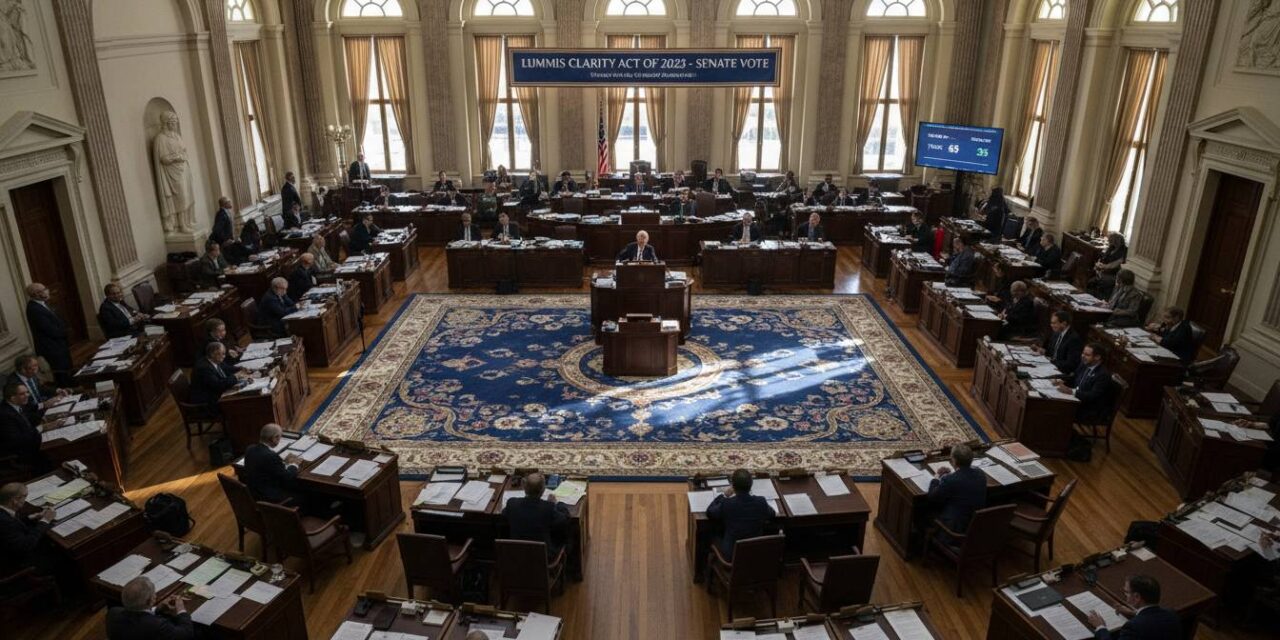
Senator Lummis says the Clarity Act is now highly likely to reach a full Senate floor vote before August. The bill cleared the Senate Banking Committee with a 15-9 vote on May 16, following months of bipartisan negotiations during the second quarter of 2026. Industry observers now put the odds at 75% for a floor vote within the next thirty days, citing intensifying News/clarity-act-could-unlock-2t-says-ripple-clo/” rel=”nofollow noopener”>Crypto lobbying and institutional urgency, according to Galaxy Research as reported by Coinpedia:041807a6a094b:0-clarity-act-update-senate-floor-vote-expected-within-30-days-as-galaxy-research-puts-odds-at-75/” rel=”nofollow noopener”>TradingView.
The Clarity Act aims to define clear federal regulations for cryptocurrencies and stablecoins.
The Banking Committee’s May 16 vote gave the Clarity Act a commanding lead over rival cryptocurrency frameworks. The Digital Markets Integrity Act and Stablecoin Trust Act both failed to advance past subcommittee review.
Galaxy Research reports Senate engagement on digital asset regulation expanded swiftly in 2026.
The 15-9 committee vote gave the Clarity Act a decisive lead, according to Cryptotimes.
Data demonstrates Senate engagement and public hearings around digital assets hit an all-time high in 2026, driven by investor anxiety and pressure from institutional investors to create a national framework. The table shows the Clarity Act leads pending crypto bills by every metric among its current rivals.
| Bill | Committee Vote | Bipartisan Sponsors | Expected Time to Floor Vote |
|---|---|---|---|
| Clarity Act | 15-9 | 6 | 4 weeks |
| Digital Markets Integrity Act | Did not advance | 3 | N/A |
| Stablecoin Trust Act | Stalled in subcommittee | 2 | N/A |
75% — Probability of July floor vote, according to Galaxy Research’s latest analysis.
Latest news
Treasury’s May 13 warning about risks from stablecoins and digital asset custodians sparked a new round of bipartisan negotiations, according to Coingape. Senator Lummis described the May 20 working session as the “most productive negotiating window” for crypto policy this year. So Senate Majority Leader Chuck Schumer confirmed the Clarity Act will be scheduled for floor time if bipartisan consensus is realized, setting June 18 as the deadline for all technical committee markups.
Bipartisan compromise is necessary for the Clarity Act to pass. We’re working around the clock to ensure stablecoin rewards are protected and to prevent deposit flight from community banks.
— Senator Cynthia Lummis (@SenLummis) March 25, 2026
America’s financial future is at stake now— we can’t wait until 2030 for another chance.
The $23.2 million crypto lobbying spend in the first half of 2026 marked a 38% increase since January, industry groups have briskly scaled up efforts reflecting just how much is at stake. Analysts note the Blockchain Association warned that without a floor vote before summer recess, fragile market confidence could suffer further damage.
More news from Coinpedia
Senate staff held detailed working sessions on May 17 and May 20 to refine token classification rules for the Clarity Act, as CoinGape reports.
- Token differences addressed:The latest draft separates payment stablecoins from investment tokens, aiming for tighter classification and oversight.
- Renewed staff meetings:Primary drafting sessions occurred May 17 and May 20 to address committee member concerns.
- Bipartisan aim:Technical reconciliation is targeted for July 1 to give the bill a clear path to the Senate floor.
What’s Next For The CLARITY Act?
A technical markup session is set for June 18, according to CryptoTimes. Senate Majority Leader Schumer directed the Banking Committee to finalize the bill by then and promised floor discussion if bipartisanship holds.
Galaxy Research puts passage probability at 75%. Committee agreement on technical language and resolve from Senate leaders are now critical factors. If the final bill text isn’t ready by July 1, passage odds may fall below 50%.
- June 18 – Banking Committee markup and technical reconciliation
- July 1 – Target for final consensus bill text
- July 7–16 – Likely floor vote period
- August 1 – Senate summer recess begins
The Need For Crypto Regulation In U.S.
According to CryptoTimes, April 2026 saw digital asset spot trading volume on U.S.-connected exchanges surge to $920 million — a 47% increase over the prior year. The rapid growth continued even as regulatory uncertainty stays high. Analysts note roughly 90% of daily trading flows for U.S.-issued stablecoins now occur on offshore-regulated platforms, reflecting federal ambiguity and enforcement gaps.
Senator Lummis and colleagues from both parties warn that the lack of federal clarity endangers investor protections and could erode American fintech dominance. Multiple Senate hearings have spotlighted fears that Asia and Europe could set investor norms first, causing capital to flow away from U.S. markets. The Blockchain Association described the lack of federal law as a drag on institutional crypto inflows in its latest testimony.
🚨🇺🇸 CLARITY DELAY 🇺🇸🚨
— John Squire XRP 🇺🇸 (@TheCryptoSquire) May 19, 2026
Senator Cynthia Lummis says there’s still “a lot of work to do” on the CLARITY Act 👀
Even if the bill passes the Senate, she warns it could take at least 18 months before it officially goes into effect.
Crypto regulation is coming… but not overnight. pic.twitter.com/iD4rbKLMZc
Bipartisan pressure is now trained on closing the gap between state and federal rules. Patchwork regulations have left both investors and U.S. platforms exposed. Industry representatives say that without the Clarity Act or similar legislation, major capital launches and new products may bypass U.S. markets in 2026 and 2027, according to TradingView.
01 The Vote Breakdown
The May 16 markup saw a final committee passage of 15-9, as CoinGape reported. Four Republicans and two Democrats joined as original sponsors, showing the challenges of building bipartisan support for crypto bills. Committee Ranking Member Sherrod Brown led the opposition, organizing a focused whip operation to narrow the bill’s scope and keep pressure on undecided members.
The nine “no” votes cited ongoing concerns that the Clarity Act doesn’t provide robust enough DeFi guardrails or easy recourse for consumers. Senators Sinema and Warner — two of the most-watched Democratic crossovers — both voted to advance the bill but held back from committing to supporting it on the Senate floor until technical language is finalized, as noted by TradingView.
| Senator | Party | Stance |
|---|---|---|
| Lummis | R | Sponsor – Yes |
| Sinema | D | Yes – Floor undecided |
| Warner | D | Yes – Floor undecided |
| Brown | D | No |
| Toomey | R | Yes |
| Wyden | D | No |
02 Two Democrats Crossed Over, But Both Held Back Their Final Votes
- Sinema’s conditions:Specific investor disclosure rules and reinforced SEC fraud oversight must be included.
- Warner’s conditions:State power over trading restrictions must be maintained for Warner’s support.
- Floor vote status:Both senators are still undecided as of late May, pending further amendment text.
03 What Got Cut and What Survived
The final bill draft saw major edits after feedback from moderate Democrats and several state banking associations, according to CoinGape. The initial plan to preempt all state stablecoin regulations, as well as an expansive DeFi safe harbor, were both deleted from the May 15 text.
The new compromise prohibits algorithmic stablecoins unless they are registered with the CFTC or a comparable federal regulator. Payment stablecoins are separated from investment tokens, with payment tokens slipping under OCC and Federal Reserve supervision.
- Dropped:Mandatory pre-emption of state stablecoin laws and the DeFi safe harbor provision.
- Kept:Safe harbor for wallet providers and payment token segregation under OCC oversight remain in the bill.
- New:Registration mandate for algorithmic stablecoins and clarified SEC–OCC/FRB division of token oversight.
06 Updated Timeline From Here
Senate Banking Committee sources say a full Managers’ Amendment is due by June 15, according to CryptoTimes. The timeline shows June 18 for the official technical markup, with Senate public hearings from June 22–25. Thirteen hours of floor debate are set between July 8 and July 15.
If the Senate misses that window, the process slips to September or later, as Congress goes on summer recess.
- June 15: Managers’ Amendment (consensus text) published
- June 18: Technical markup and final committee action
- June 22–25: Senate public hearings
- July 8–15: Senate floor debate window (thirteen hours allotted)
- July 16: Senate floor vote target date
07 Can Crypto Be Fully Regulated by August?
The Clarity Act closes the biggest policy gaps but leaves issues — AML compliance, consumer redress, privacy, and DeFi oversight — for future bills. Several related proposals are active in both chambers, but only the Clarity Act likely reaches a Senate floor vote this summer. Surveys by Galaxy Research, cited by TradingView, indicate further legislation will be needed in 2027 to address full digital asset regulation.
08 Best Case, Realistic, and Slow Scenarios
The best scenario sees the Senate pass the Clarity Act by July 16.
The slowest scenario involves filibuster or failure to reach a vote by summer, which would require reintroduction in 2027 and erase months of momentum and cross-party coordination.
| Scenario | Target Date | Odds (Galaxy Research) | Market Impact |
|---|---|---|---|
| Best Case | July 16, 2026 | 75% | Q3 regulatory certainty; launches proceed |
| Realistic | August–September 2026 | 20% | Regulatory delay; increased uncertainty |
| Slowest | 2027+ | 5% | Reintroduction; momentum lost |
5% — Chance of failure in current session
Frequently Asked Questions
- Q: What is the Clarity Act?
A: It’s a federal legislative package aiming to clarify categories and agency roles for cryptocurrencies, stablecoins, and their intermediaries across the U.S. The goal is to resolve overlapping state and federal rules for the industry. - Q: Who are its main sponsors?
A: Senators Cynthia Lummis and Kirsten Gillibrand lead the bipartisan group, joined by four Republican and two Democratic co-sponsors as of May 2026, according to CoinGape. This team is rare in crypto regulation. - Q: When is the Senate vote expected?
A: Galaxy Research sets the probability at 75% for a July 7–16 full Senate floor vote, in order to finish before the August recess. Timing is tight. - Q: What are the main sticking points?
A: The token classification, DeFi regulation scope, and consumer protection language are the most contested issues. - Q: How has industry responded?
A: Lobbying hit $23.2 million for the first half of 2026, and industry leaders are pushing hard for speed, with billions in institutional capital waiting, according to CryptoTimes. The outcome could reshape the sector.
For deeper coverage of Lummis indicates Clarity Act may reach Senate vote by mid-July, visit our latest articles. Reach out with questions or for updates as the legislative timeline develops.
Disclaimer: The content on this page is for informational purposes only and does not constitute financial advice. Always do your own research before making investment decisions.

James Nakamoto is a Bitcoin core contributor and cryptocurrency journalist with 13 years of industry experience. Having mined Bitcoin in 2012 and contributed to BIP discussions, James brings unmatched technical depth to his reporting. He previously led research at Blockstream and has been published in Bitcoin Magazine since 2014. James is a sought-after voice on monetary policy, mining economics, and the Lightning Network.
Conflicts of interest
I disclose any positions held at time of writing within each article. I do not trade Bitcoin futures.