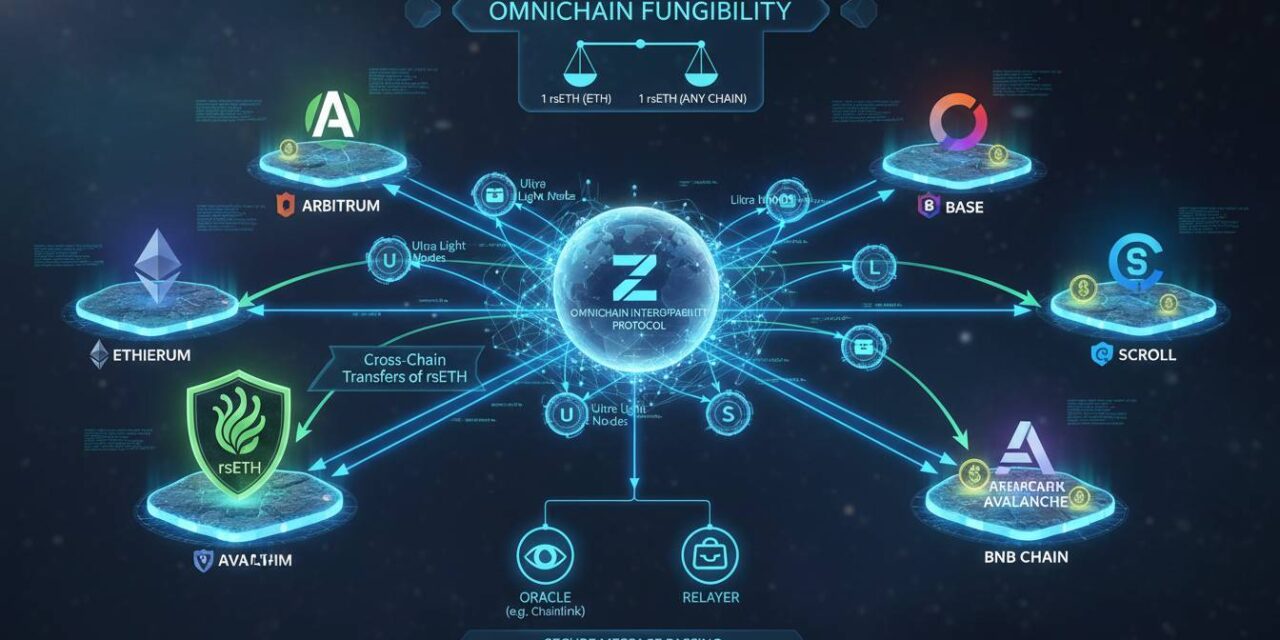
- KelpDAO suffered a $292 million exploit in March 2026, marking the largest DeFi hack of the year.
- LayerZero implemented new security measures, including multisignature requirements and mandatory off-chain validator updates, following the exploit.
- KelpDAO migrated to Chainlink's Cross-Chain Interoperability Protocol on March 24, 2026, to enhance security.
- Over $1.3 billion in bridge hacks occurred in DeFi from 2021 to 2026, prompting industry-wide security upgrades.
This article is for informational purposes only. Always verify information independently before making any decisions.
The recent $292 million KelpDAO exploit has significantly shaken the DeFi landscape, prompting urgent calls for enhanced security protocols across the industry.
LayerZero has disclosed technical and procedural failures behind the $292 million KelpDAO bridge exploit, which immobilized significant ETH reserves and shook DeFi security. Chainalysis ranks this as the largest decentralized finance hack of 2026, a blow that triggered urgent protocol upgrades and forced an industry-wide reevaluation of security best practices.
LayerZero’s postmortem revealed new multisignature requirements, mandatory off-chain validator updates, and mandatory partnerships with external auditors, according to Galaxy‘s incident analysis.
LayerZero Admits Communication and Configuration Failures
Findings described in Coinpaper‘s exploit report confirm that off-chain verifier upgrades were mandated in February 2026. However, no automated system checked that all validator software was updated by protocol members. When KelpDAO’s team got patch instructions, they misunderstood them as optional. Miscommunication escalated a minor gap into a critical vulnerability. Poor documentation and protocol enforcement deepened confusion between LayerZero and KelpDAO, creating a dangerous gap between policy and practice.
LayerZero publicly admitted both inadequate onboarding documentation and poor reporting for validator changes—highlighting organizational shortcomings, according to The Market Periodical.
KelpDAO Moves to Chainlink After Exploit
Galaxy reports KelpDAO lost over $290 million in assets as attackers drained bridge contracts during the March 2026 exploit. In response, KelpDAO left LayerZero and, on March 24, 2026, announced a migration to Chainlink’s Cross-Chain Interoperability Protocol (CCIP).
RECAP: @KelpDAO's LayerZero-powered bridge is drained of 116,500 $rsETH worth ~$292M, roughly 18% of circulating supply, in the largest DeFi exploit of 2026, triggering emergency freezes across @AaveAave, SparkLend and Fluid. pic.twitter.com/YCwROGgTdKView on X
Migrating required full redeployment of cross-chain vaults and all user staking derivatives. NFT Plazas says Chainlink’s verifiable random function and CCIP’s audited security replaced compromised LayerZero bridge logic.
KelpDAO’s engineering team moved rapidly to onboard third-party audit firms CertiK and Trail of Bits, aiming to restore user trust after the breach, Coinpaper reports. All migrated bridges and vaults had to pass snapshot security reviews before user services relaunched. Recovery also meant freezing all KelpDAO user deposits, rotating keys, and distributing staking ETH plus derivative vouchers for claim on new Chainlink-powered networks.
Leading DEX partners and DeFi aggregators channeling user funds through the old bridge saw considerable losses, according to Galaxy’s postmortem. In response, KelpDAO blacklisted all vulnerable token contracts, froze suspect endpoints, and coordinated with DAO partners to halt bridge activity on affected chains.
KelpDAO’s new CCIP integration now delivers modular live health monitoring, offering instant breach detection and real-time audit trails to DAOs and users, says The Market Periodical.
DeFi United, Frozen ETH, and LayerZero’s Security Changes
Galaxy’s ecosystem analysis states the $292 million KelpDAO exploit sparked emergency “security hardening” sector-wide. LayerZero at pace enforced a multisignature upgrade for all core protocols, including Stargate and SushiXSwap, within days of the March breach.
https://t.co/3vIHs3Xgs4View on X
On-chain heartbeat checks, automated liveness proofs, and rollback controls for protocol reboot were released to production in a May 2026 overhaul, according to Kucoin‘s incident recap.
KelpDAO, FreewayDAO, and other directly affected protocols lost tens of millions in total value locked overnight. NFT Plazas data show these staking pools were hit by the user asset freeze. Rival bridges like Wormhole, Synapse, and Multichain then launched anti-tamper verification and new dashboards—direct responses to LayerZero’s defense improvements.
According to NFT Plazas, Chainlink’s governance reports show that more than $1.3 billion in bridge hacks hit DeFi from 2021 to 2026, driving standards for risk-based insurance and more diverse validator sets.
The Market Periodical describes how leading projects now apply LayerZero’s documentation and audit standards to secure their own assets.
- Feb 2026:LayerZero requires verifier logic upgrades for KelpDAO’s bridge contracts.
- Mar 19, 2026:Unpatched validator code is exploited; sizable ETH reserves stolen from user vaults.
- Mar 24, 2026:KelpDAO announces migration to Chainlink CCIP and pauses LayerZero bridge.
- Apr 3, 2026:Compulsory multisignature and validator rotation protocols initiated for all DeFi bridges by LayerZero.
- May 2026:Industry adopts real-time monitoring, public dashboards, and rolling audits across all bridges.
GalaxyOne for Individual Investors Now Available
GalaxyOne—the flagship DeFi dashboard—launched retail support in March 2026 after originally serving only institutional clients, Galaxy confirms.
With support for legacy KelpDAO, LayerZero, and Chainlink holdings across all affected blockchains, users can now create asset recovery plans, Galaxy reports. In its first month, The Market Periodical’s user survey found thousands of new signups, with substantial frozen asset volumes per portfolio.
LayerZero and Galaxy describe how GalaxyOne integrates with Chainlink CCIP feeds and LayerZero API, letting investors see which assets are frozen, migrated, or claimable post-exploit.
The dashboard’s onboarding campaign of webinars and self-recovery guides boosted user claim success rates, according to The Market Periodical.
Galaxy’s 2026 roadmap states that the next major GalaxyOne release will include automated redemption scheduling, push notifications for changes in multisig votes, and AI-powered validator downtime monitoring.
Developing Infrastructure for an AI-Enabled Future
LayerZero’s Q2 2026 updates in Coinpaper highlight how AI-driven exploits and automated scripts have raised both risk and workload for all DeFi infrastructure teams.
Rather than depending on static code analysis alone, new security services model adversarial tactics, probe potential attack surfaces. Validate protocol behavior in edge-case scenarios, as reported by The Market Periodical. LayerZero reports that quarterly adversarial simulation events bring public red-teamers and generative AI adversaries into every review. Galaxy notes that every cross-chain transaction over $500,000 now gets automated risk scoring.
Since April 2026, LayerZero’s infrastructure summits feature deep dives on multisig validator gating, live protocol rotation, and AI-driven escalation techniques, The Market Periodical reports.
Recent Insight
LayerZero and Chainlink, as cited in Coinpaper, agree the KelpDAO exploit forced a swift evolution in DeFi governance and protocol recovery frameworks.
According to KuCoin’s timeline, the scale and speed of the March exploit triggered coordinated security upgrades among LayerZero, KelpDAO, Chainlink, Wormhole, and Galaxy.
Both KelpDAO and LayerZero published full post-incident transparency dossiers, according to The Market Periodical.
NFT Plazas, citing Chainlink’s April 2026 bulletin, reports $4.7 billion in cross-chain assets were flagged “at risk” by AI-driven monitoring after the LayerZero-KelpDAO breach. Nearly 75% of these assets sit on just ten bridge protocols, greatly concentrating systemic exposure.
Invest, Build, Transform — Relentlessly
LayerZero, KelpDAO, and Chainlink are making scaled investments in decentralized risk mitigation and secure protocol development, according to LayerZero’s Q2 2026 roadmap reviewed by The Market Periodical.
Proactive white-hat testing and live pen-testing events led to dozens of critical patches delivered within weeks of the KelpDAO exploit, per LayerZero’s security logs cited by Coinpaper. According to Galaxy estimates via KuCoin, total industry security infrastructure spending will exceed $1 billion through 2027.
Chainlink and LayerZero, as highlighted by NFT Plazas, stress that regular reinvestment, transparency, and post-incident user care predict DeFi capital inflows.
Full Timeline: LayerZero & KelpDAO Exploit Response
- Feb 2026:LayerZero directs KelpDAO to implement central verifier logic updates.
- Mar 19, 2026:Unpatched validator code enables coordinated theft of user vault ETH.
- Mar 21, 2026:KelpDAO initiates brisk migration to Chainlink’s CCIP.
- Mar 24, 2026:KelpDAO officially halts LayerZero bridge and asks users to withdraw funds.
- Apr 1, 2026:KelpDAO relaunches liquid staking through Chainlink; LayerZero freezes suspect contracts.
- Apr 3, 2026:Mandatory multisignature, validator rotation, and asset recovery protocols enacted across LayerZero bridges.
- Apr 15, 2026:Cross-bridge working group publishes synchronized upgrade schedule and guidance.
- May 2026:GalaxyOne and competitors roll out affected asset tracking dashboards for retail users.
- May 10, 2026:Ongoing audits and first insurance claims processed for incident response.
- KelpDAO exploit:$292M stolen across multiple chains during March 2026.
- LayerZero response:Industry-standardization of multisig, audit, and validator protocols initiated within weeks.
- Chainlink migration:KelpDAO resumes full operations on new CCIP bridge architecture after three weeks.
- AI-driven defense:Automated transaction monitoring, insurance, and quarterly audits become industry baseline.
- User impact:Thousands tracked bridge losses via GalaxyOne; most frozen pools scheduled for phased recovery in Q3 2026.
For more in-depth LayerZero details $292M KelpDAO exploit and tightens bridge security articles, track the latest protocol upgrades and asset recovery initiatives. Contact us for technical updates on LayerZero, KelpDAO, and cross-chain DeFi security trends.
On Google, tick the box next to stnews.live to see our reporting higher in Top Stories.
Disclaimer: The content on this page is for informational purposes only and does not constitute financial advice. Always do your own research before making investment decisions.

Sarah Williams is STnews's Blockchain Editor, leading coverage of blockchain technology, DeFi investigations, exchange analysis and crypto regulation. Her reporting adheres to STnews's editorial standards — primary-sourced, cited, and non-advisory.
Conflicts of interest
I hold no positions in any cryptocurrency mentioned in my coverage. All investment-related content is reviewed by senior editors before publication. I am not compensated by any project I cover.