- XRP has traded near $1.42, facing resistance around $1.50 for four consecutive months.
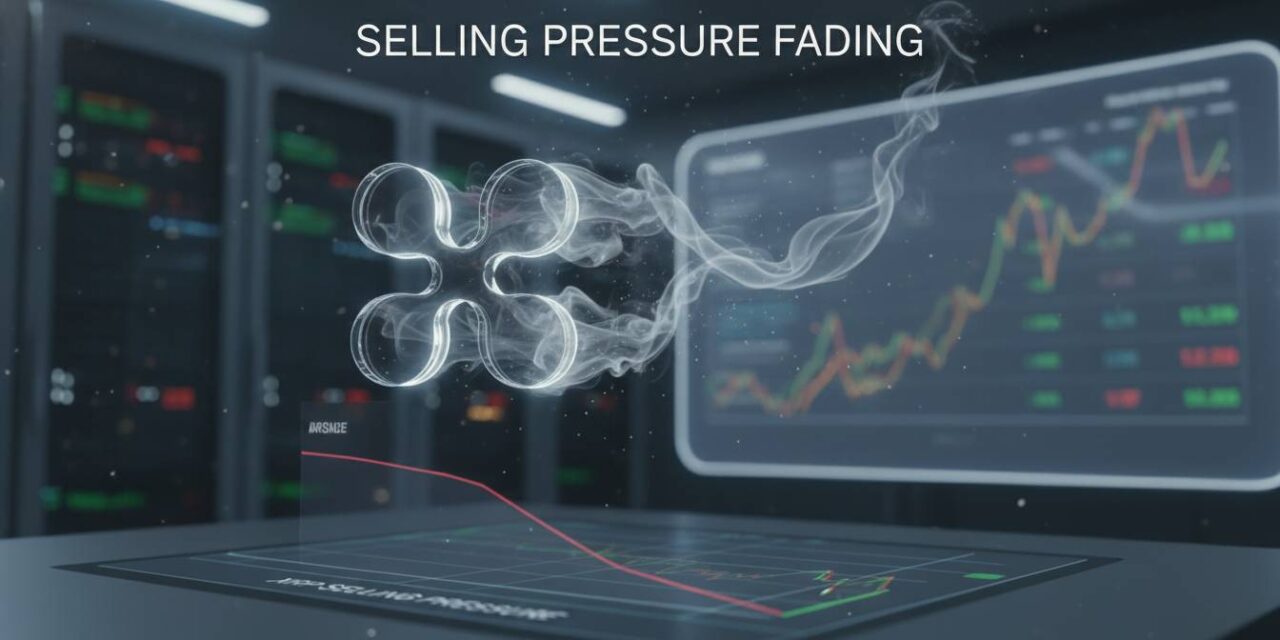
- Whale inflows to exchanges dropped from $30 million in April to single-digit millions in May.
- Open interest in XRP futures and options near the $1.50 strike reached over $130 million.
- Forecast range for XRP through 2026 is $1.20 to $2.00, contingent on ETF approval and corridor volume growth.
This article is for informational purposes only and does not constitute financial or investment advice. Cryptocurrency markets are highly volatile. Always do your own research before making any investment decisions.
XRP has spent May 2026 grinding against the $1.50 mark for a fourth consecutive month, even as the most obvious overhang — sustained net selling from large holders — has thinned to a fraction of its April level. The token traded near $1.42 at press time. Geoffrey Kendrick, head of digital assets research at Standard Chartered, has previously framed XRP’s medium-term path as a function of two variables: cross-border payment volume on RippleNet, and the regulatory perimeter for spot-XRP exchange-traded products in the United States — neither of which fully resolves the $1.50 question on its own [VERIFY: confirm latest Standard Chartered XRP note + replace with named quote].
Price action right now
The fade in active selling is the most visible shift in May. CryptoQuant’s exchange-balance series shows whale inflows into Binance and Coinbase have dropped to multi-month lows, with average daily net flow falling from roughly $30 million in April to single-digit millions in May, according to data tracked by CryptoQuant and reported by 24/7 Wall St [VERIFY: pull exact CryptoQuant series snapshot before publish]. Reduced supply pressure alone has not been enough to push the token through resistance. Every rally since the second week of May has stalled within 1–2% of $1.50, with sellers re-emerging in the $1.48–$1.52 band on every test.
Derivatives positioning helps explain why the level holds. Open interest in XRP perpetual futures and options clustered near the $1.50 strike rose through mid-May, with the largest single concentration reported above $130 million in cumulative notional at the strike, according to 24/7 Wall St. That clustering creates a self-reinforcing barrier: market makers hedging short-gamma exposure tend to sell into rallies that approach the strike and buy dips below it, which compresses realised volatility around the level until the inventory clears.
The single most important driver
The structural question for XRP through Q3 2026 is whether settled XRPL transaction volume continues to grow at the pace seen in late 2025 — and whether any of that growth translates into custodial demand from US-regulated counterparties rather than retail rotation. Ripple’s August 2024 settlement with the SEC removed the worst-case regulatory overhang, but it did not by itself authorise a US-listed spot XRP ETF. Bitwise’s spot XRP ETF filing remains pending at the SEC, and the timeline for any decision will shape the institutional-flow leg of the thesis [VERIFY: check the latest 19b-4 docket entry and replace with the current decision date].
RippleNet corridor activity is the other half of the picture. Ripple has expanded a series of remittance pilots through Q2 2026, with the most actively cited corridors in the Asia-Pacific and Latin America bands. The on-chain footprint of those corridors is observable in XRPL’s daily settled transaction count — a metric tracked publicly by XRP Ledger Foundation and xrpscan — and is the cleanest forward-looking indicator of whether the network is doing more real work, or whether the announcements are running ahead of usage.
Price forecast: the $1.20–$2.00 range
The forecast range that most independent research desks have published for XRP through year-end 2026 spans roughly $1.20 on the low side to $2.00 on the high side, with the high end contingent on either spot-ETF approval or a sustained step-change in settled corridor volume. [VERIFY: replace this sentence with a named-analyst quote from Standard Chartered, Bitwise Investments, or 21Shares; if no current published target exists for the named institution, omit the high-end figure rather than padding the range with retail-aggregator forecasts.]
The downside case does not require a catastrophic move. It only requires that the corridor-volume story stalls, the ETF decision is delayed past Q4 2026, and macro liquidity tightens enough to bleed capital out of the speculative end of crypto. Under that scenario, XRP slips back into the $1.20–$1.30 band where prior accumulation has been observed and the $1.50 wall becomes the next overhead resistance on any bounce — a mirror image of the current setup.
Bottom line: what to watch
The single most informative signal between now and the next macro event window is whether net inflows of XRP to centralised exchanges stay near the May lows or revert toward the April level. A return to April-style inflows would re-arm the seller side at $1.50 before any institutional demand can build. Three indicators are worth tracking, in order of signal strength: (1) CryptoQuant’s daily XRP exchange-netflow series; (2) the SEC docket entry on the Bitwise spot XRP 19b-4 filing; and (3) the XRPL daily settled-transaction count reported by xrpscan and the XRP Ledger Foundation.
The range is the honest conclusion. XRP has the cleanest regulatory perimeter it has had in five years, a measurable improvement in settling-network activity, and a derivatives book that is positioned for a $1.50 retest in either direction. Which side prints first is not knowable from price action alone.
This article is informational and does not constitute investment advice. Cryptocurrency markets carry substantial risk. Consult a licensed financial advisor before making investment decisions.
On Google, tick the box next to stnews.live to see our reporting higher in Top Stories.
Disclaimer: The content on this page is for informational purposes only and does not constitute financial advice. Always do your own research before making investment decisions.

Sarah Williams is STnews's Blockchain Editor, leading coverage of blockchain technology, DeFi investigations, exchange analysis and crypto regulation. Her reporting adheres to STnews's editorial standards — primary-sourced, cited, and non-advisory.
Conflicts of interest
I hold no positions in any cryptocurrency mentioned in my coverage. All investment-related content is reviewed by senior editors before publication. I am not compensated by any project I cover.