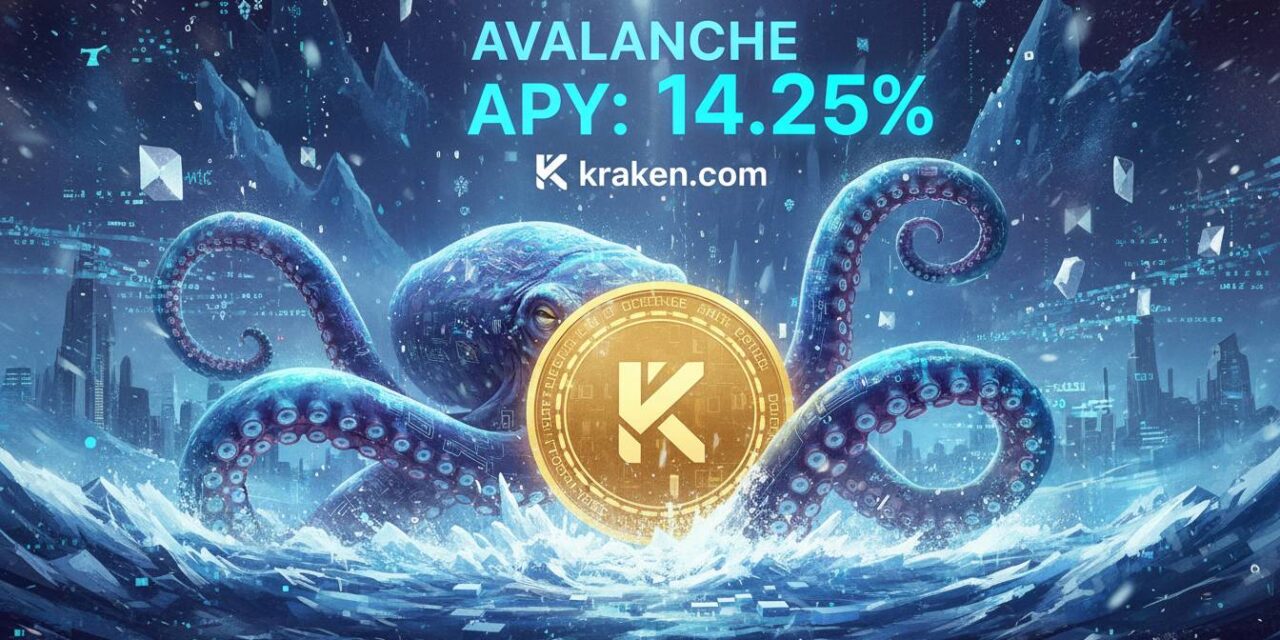
- Kraken launched Avalanche staking on May 22, 2026, offering up to 10% APY through Bonded Staking.
- Bonded Staking's promotional rate drops to 7% after the initial period; Auto Earn and Flexible Staking offer up to 3.5% APY.
- U.S. residents in New York and Maine are excluded from AVAX staking due to state regulations.
- Kraken's staking products automate rewards compounding, simplifying the staking process for users without technical knowledge.
This article is for informational purposes only. Always verify information independently before making any decisions.
Kraken launched Avalanche staking on May 22, 2026, offering promotional rates up to 10% APY on AVAX through its Bonded Staking product. The service delivers three distinct options—Bonded Staking, Auto Earn, and Flexible Staking—catering to users seeking 3.5% to 10% APY. All products automate rewards compounding on behalf of the user. The 10% APY for Bonded Staking is temporary, falling to 7% after the promotional period.
Kraken manages all validator operations and reward distributions, so users don’t need to interact directly with the Avalanche network. Eligible holders in supported regions outside certain restricted areas can now earn staking yields through this offering. The move positions Kraken as a high-visibility player in the AVAX staking sector—a direct challenge to Binance and Coinbase, which have dominated exchange-based AVAX yields for years.
Three flavors of yield: Kraken’s AVAX staking suite
Bonded Staking, Auto Earn, and Flexible Staking. Bonded Staking—the headline product—delivers up to 10% APY during its promotional period, then tapers to a long-term rate of 7%.
Auto Earn, the mid-tier AVAX staking option, provides yields up to 3.5% APY and stands out for automatically reinvesting staking rewards back into the user’s account. It features looser lockup terms than Bonded Staking, allowing partial access with potential cooldown periods.
AVAX staking is now live on Kraken 🔺View on X
Earn up to 10% APY with bonded staking.
Auto Earn, Flexible, or Bonded. Pick your path, start earning.
Start now 👇https://t.co/sdxpe5BUpz pic.twitter.com/xCkipQ5xjJ
Flexible Staking completes the suite, also offering up to 3.5% APY and letting users unstake their AVAX with little delay.
| Product | Promotional APY | Ongoing APY | Liquidity Access |
|---|---|---|---|
| Bonded Staking | 10% | 7% | Locked (fixed term) |
| Auto Earn | 3.5% | Likely similar or lower | Partial (cooldown may apply) |
| Flexible Staking | 3.5% | Likely similar or lower | High (near-instant unstake) |
Kraken adopted an auto-restake model for all AVAX staking products, automatically compounding rewards. Compound growth is achieved by rolling earned AVAX back into existing user staking positions each cycle. This approach accelerates overall APY for engaged participants and removes user-side complexity in compounding. Also, Kraken’s infrastructure abstracts away validator selection, node uptime, and AVAX on-chain management, so users don’t need technical knowledge or a network wallet. By eliminating those frictions, the service opens staking to a broader base—and grows AVAX engagement overall. Analysts note this accessibility-first approach mirrors strategies used successfully by Coinbase and Binance.
Who can actually use this: eligibility and restrictions
Kraken’s AVAX staking suite is available to most global users, but with defined geographic constraints. U.S. residents in New York and Maine are categorically excluded from participating, due to state regulatory limits on crypto staking products. These exclusions mirror Kraken’s policy for other staking assets, including similar limitations on Ethereum and Polkadot staking. The United Kingdom, European Union, Canada, and Australia feature additional regional restrictions, with eligibility details outlined in Kraken’s compliance documentation.
- New York and Maine residents cannot access AVAX staking on Kraken due to state restrictions.
- Some regions in the UK, EU, Canada, and Australia are excluded based on local rules.
- Identity verification (KYC) and term acceptance apply to all staking tiers on the platform.
Platforms like Binance and Coinbase follow nearly identical standards when offering staking, especially where local governments regulate high-yield offerings.
What this means for investors: income, risk, and strategy
Staking AVAX on Kraken converts previously idle holdings into a direct yield stream. The initial headline APY of 10% for Bonded Staking far outpaces typical U.S. Treasury, savings, or traditional DeFi protocol returns. Once the promotional window closes, users should plan for a 7% ongoing APY as their baseline.
For the average AVAX holder, exchange staking provides portfolio utility that would otherwise require technical setup and higher capital minimums to access through Avalanche’s core wallet delegation.
7% — Ongoing Bonded Staking APY (post-promo)
While yield potential is attractive, the trade-off comes in the form of counterparty risk. Users who stake AVAX via Kraken expose themselves to exchange custody, meaning control of staked assets is relinquished to Kraken’s platform.
Kraken’s ongoing APY premium is designed to compensate for this passive trust in a centralized operator rather than self-managed custody. So the 3% premium over non-custodial alternatives reflects the cost of convenience and reduced technical burden.
For strategic planning, investors should treat the 7% APY as the most reliable long-term scenario. The extra 3% available during the promotional period should be seen strictly as a short-term bonus, not a sustainable baseline. Planning for a 10% yield indefinitely could result in overstated passive income projections and increase exposure to sudden payout changes.
- May 2026: Kraken adds Avalanche staking—rolling out Bonded, Auto Earn, and Flexible tiers in global markets.
- The promotional launch period begins, offering 10% APY for Bonded Staking participants.
- Kraken transitions Bonded Staking to a 7% APY after promo completion, maintaining competitive yields in the market.
- Auto Earn and Flexible Staking products offer up to 3.5% APY, targeting users who require less lockup and faster liquidity.
Behind Kraken’s staking infrastructure: validator ops simplified
Kraken and Avalanche: partnership background and ecosystem impact
Kraken, in formal partnership with Ava Labs, aims to strengthen the AVAX ecosystem by widening network participation and user onboarding. John Nahas, Ava Labs’ Chief Business Officer, framed the partnership as an ecosystem catalyst designed to drive both utility and staking participation. Higher AVAX staking rates are expected to secure the Avalanche network and drive usage of the protocol.
Kraken’s Earn suite now hits beyond retail holders, as its tiered staking targets high-value and institutional clients. Analysts say this approach mirrors strategies used by Coinbase and Binance to capture premium segments of the staking market.
With more than 380 million AVAX locked in staking—based on data cited by Ava Labs—network security continues to rise alongside centralization risk. Exchange-led onboarding drives up both the volume of staked tokens and the share under centralized management. For the protocol, increased AVAX staking means higher attack resistance and often deeper governance participation. But it also increases scrutiny on validator distribution and single-point-of-failure risks. As centralized exchange platforms like Kraken grow their share of AVAX staking, DeFi ecosystem participants monitor the implications for network governance and validator diversity.
- The partnership is meant to accelerate ecosystem expansion and global user adoption of AVAX.
- Kraken views tiered and competitive staking products as central to brand growth in Earn services.
- Expanding AVAX staking volumes could enhance network integrity while prompting decentralization debates.
Kraken’s Earn product line, now expanded by AVAX staking, follows industry moves toward convenience, plain product segmentation, and risk-based pricing. For Avalanche, these partnerships widen the addressable user base, unlocking access for new users who wouldn’t otherwise engage directly with Layer 1 network staking.
Strategic implications: custody risk and investor best practices
Kraken’s promotional 10% APY is a deliberate lever to attract new users from competing platforms. Once the initial period ends, Kraken expects most AVAX stakers to remain for the sustainable 7% APY. Investors who mistakenly plan as if the 10% headline rate is guaranteed long-term risk disappointment. So smart investors treat base-case futures with a 7% yield scenario and consider the 3% premium as a temporary incentive.
- May 2026: Kraken launches Avalanche staking—making Bonded, Auto Earn, and Flexible products instantly available to eligible users.
- Promotional APY of 10% for Bonded Staking opens, driving early adoption and initial volume.
- Standardized rates take effect post-promotion, with Bonded Staking sliding to 7% APY.
- All tiers use Kraken’s auto-compounding engine, maximizing participant returns as AVAX rewards are applied automatically.
How Kraken’s AVAX staking shifts the competitive landscape
Kraken’s entrance into the AVAX staking market ramps up competition across major global exchanges. Binance and Coinbase have offered AVAX staking for years, but Kraken immediately differentiates through a multi-tier structure and an aggressive promotional top yield.
Market observers agree that Kraken’s AVAX staking launch signals the rising sophistication of centralized crypto Finance. As institutional interest in staking grows, exchanges that offer robust rates with plain terms will wield the most influence over network-level governance and liquidity flows. market data shows Kraken’s promo-driven launch raises the industry ceiling on what’s expected in user incentives, marking a shift toward exchange-led innovation rather than protocol-first updates.
Outlook: Exchange staking and the future of AVAX participation
Users planning to take advantage of Kraken’s AVAX staking should remain alert to potential regional access changes and continually benchmark platform yields against those of competing exchanges. Analysts say the evolution of AVAX staking demonstrates that the market for crypto rewards is dynamic, and both platforms and users must adapt with speed. The staking market moves with every APY announcement. For the latest product developments and platform coverage, visit our section on Avalanche staking with up to 10% APY.
On Google, tick the box next to stnews.live to see our reporting higher in Top Stories.
Disclaimer: The content on this page is for informational purposes only and does not constitute financial advice. Always do your own research before making investment decisions.

Sarah Williams is STnews's Blockchain Editor, leading coverage of blockchain technology, DeFi investigations, exchange analysis and crypto regulation. Her reporting adheres to STnews's editorial standards — primary-sourced, cited, and non-advisory.
Conflicts of interest
I hold no positions in any cryptocurrency mentioned in my coverage. All investment-related content is reviewed by senior editors before publication. I am not compensated by any project I cover.