This article is for informational purposes only and does not constitute financial or investment advice. Markets are volatile — always do your own research before making investment decisions.
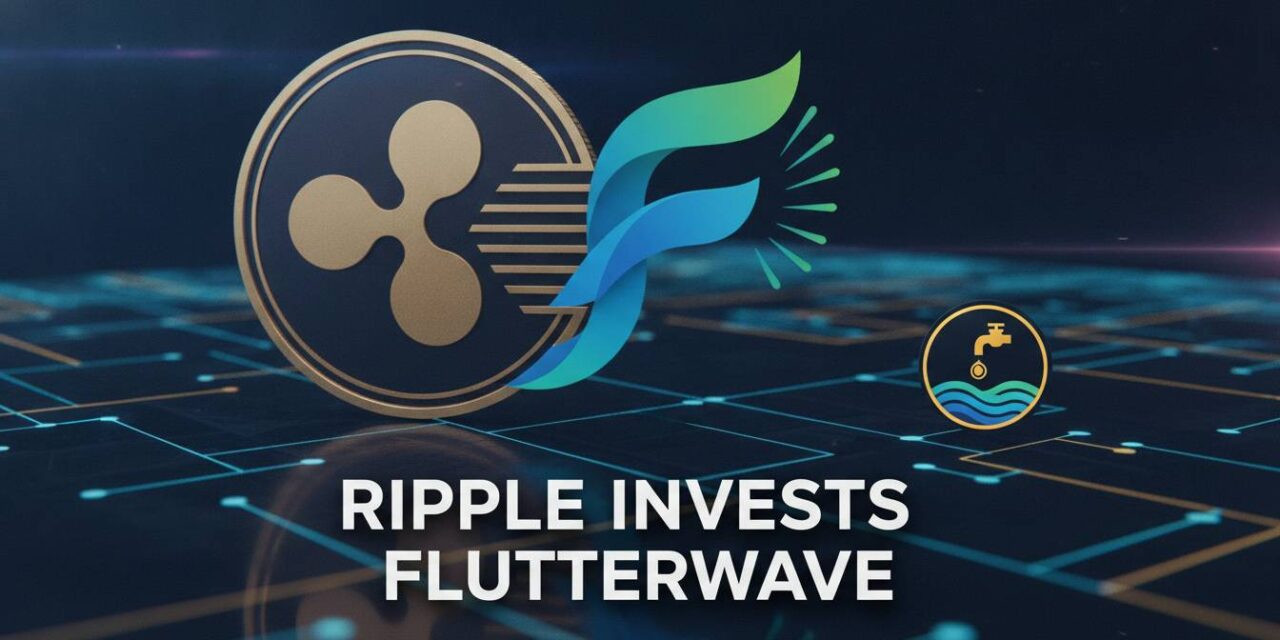
Ripple’s setting its sights on Africa’s booming remittance market, making a major investment in Flutterwave by joining the Nigerian fintech’s Series E round at a valuation north of $3.2 billion, reports Businessday and Prnewswire. That $3.2 billion valuation—driven by Flutterwave processing more than a billion transactions totaling over $50 billion—shows just how fast digital payments are taking off across the continent.
Businessday reports Ripple’s overall company valuation at around $50 billion and confirms the company made an undisclosed investment in Flutterwave’s latest round, giving the pan-African payments challenger a $3.2 billion status. Because Flutterwave’s processed transactions and $50 billion of flows reflect real market demand, it serves as a live, high-volume testbed for next-generation payment rails. Ripple’s RLUSD stablecoin—pegged to the US dollar since its December 2024 launch—steps in as the main route to send and convert funds across borders.
And the integration of RLUSD within Flutterwave’s own infrastructure is a bet on tackling Africa’s punishing remittance costs and breaking open intra-African economic flows at scale. RLUSD’s race to a $1 billion market cap, notched within just a year as noted by Prnewswire’s report, signals rapid adoption and a level of institutional trust that few new assets can claim.
Remittance Challenges and Market Opportunity
Businessday points out fees frequently top eight percent, which is more than double the global average and especially hard on the millions who rely on remittances for daily life. Flutterwave’s funding momentum, paired with Ripple’s blockchain tech, positions their combined network as a real contender to cut those stubborn costs by embedding RLUSD and other crypto tools right at the settlement layer. According to Techfinancials’ coverage, Flutterwave’s infrastructure already connects local banks, mobile wallets, and international transmitters in more than 30 African countries.
This broad reach means Ripple isn’t just conducting another pilot—RLUSD and the XRP Ledger will be tested in genuine, high-volume environments. The timing lines up with regulatory changes, such as the Central Bank of Nigeria’s Anti-Money Laundering supervision pilot—launched in March 2026—focused on tighter oversight for Virtual Asset Service Providers.
Integrating RLUSD and Blockchain
RLUSD launched in December 2024 and rocketed past a $1 billion market cap, according to Businessday—making it central to Africa’s new cross-border payment rails. RLUSD is natively at home on the XRP Ledger, which makes instant settlement and minimal slippage not just possible, but expected on international transactions.
The open, trustless architecture of the XRP Ledger is a game-changer here, allowing real-time transfers between different countries and cutting out the slow, lumbering correspondent banking chains. Old-fashioned wires struggle to compete on cost or speed. That matters most for Africa, where currency jitters and a constant squeeze on USD liquidity have made cross-border payments risky and expensive. By routing cash through RLUSD, Flutterwave can offer near-instant cashouts or mobile money credits in local currency—directly threatening legacy money-transfer operators stuck on traditional rails.
Regulatory Landscape and Compliance
In March 2026, the Central Bank of Nigeria started an Anti-Money Laundering supervision pilot giving select Virtual Asset Service Providers—such as Flutterwave and Ripple—a chance to operate within a regulatory sandbox, according to Businessday. As African regulators try to juggle consumer protection and innovation, remittance operators need to show robust compliance or risk being shut out by banks entirely. Prnewswire confirms that Flutterwave already has solid frameworks; plus, Ripple’s track record for compliance in multiple OECD countries could help smooth out the licensing process locally.
Techfinancials reminds us that earlier pilot regimes have resulted in real regulatory action—cross-border crypto products have been blocked before, and eNaira’s retail performance was disappointing. Over the next 12 months, onboarding and transaction audits across Nigeria, Kenya, and Ghana will test just how far the Ripple–Flutterwave partnership can go in creating mass-market remittance options in Africa’s largest economies.
Market Impact and Competition
Businessday calculates remittance flows to sub-Saharan Africa topped $50 billion in 2025—beaten only by foreign direct investment and development aid. Traditional operators like Western Union and MoneyGram have long dominated thanks to entrenched networks. But now they’re feeling competitive pressure from mobile solutions and crypto-backed payment rails, as there is a broader shift towards more flexible and cost-effective options for consumers. Techfinancials notes Flutterwave’s activity across African countries means cross-platform transaction routing is crucial. Flutterwave’s API model lets merchants plug into global cards, local banks, and digital wallets alike, aligning perfectly with Ripple’s plan to make RLUSD the default settlement token across much of the continent.
Technology Execution and Next Steps
Ripple’s immediate technical goal—corroborated by Prnewswire and Businessday—is fully integrating RLUSD into Flutterwave’s backend and launching pilot corridors from the United States, UK, and Gulf states to Nigeria and Kenya by the end of 2026. This expansion leans on Ripple’s proven compliance backbone to meet changing regulatory standards, and it’ll allow instant payments even in countries with currency volatility or tight controls. The rollout’s set to be phased, with diaspora communities in Europe and North America among the first to benefit.
Techlabari stresses that real-world adoption hinges on interoperability—support for USSD, mobile money, and agency banking networks isn’t optional for reaching every user segment. Should RLUSD-backed remittance flows grow as planned, research indicates that both informal cash remitters and traditional cross-border wires could lose substantial volume to these new rails.
Broader Implications for Africa
Businessday and Techfinancials both note Ripple’s Flutterwave investment isn’t just a fintech story—it’s a signal that Africa has moved from being a testing ground for blockchain to an active frontline in the race for global crypto infrastructure.
The model Ripple and Flutterwave are piloting—if it delivers faster, cheaper, and more reliable remittance—could serve as a blueprint for stablecoin adoption continent-wide, from Lagos to Nairobi.
Milestones and Outlook
The stakes for Ripple and Flutterwave are high—they’re racing to deliver always-on, at-scale remittances.
Regulatory approvals—especially from the Central Bank of Nigeria—will determine just how quickly funds can land in African mobile wallets. Meanwhile, market data shows both firms will be judged on onboarding speed and their ability to lure everyday users away from the likes of Western Union by promising real savings, convenience, and dramatic improvements in payment speed. In the end, Ripple’s hope is that RLUSD and the XRP Ledger—battle-tested by Africa’s dynamic corridors—will become a launchpad for much bigger ambitions in emerging markets everywhere.
On Google, tick the box next to stnews.live to see our reporting higher in Top Stories.
Disclaimer: The content on this page is for informational purposes only and does not constitute financial advice. Always do your own research before making investment decisions.

Elena Petrova is a regulatory correspondent specializing in crypto law and policy with over 10 years of financial journalism experience. Formerly a finance reporter at Reuters, Elena covers SEC enforcement, MiCA implementation, and global stablecoin regulations. She holds a J.D. from Georgetown Law and is a member of the New York State Bar. Her regulatory analysis is frequently referenced by compliance officers and legal teams at major exchanges.
Conflicts of interest
I have no current legal practice or retainer relationships with any cryptocurrency company. Past employment relationships are listed publicly.