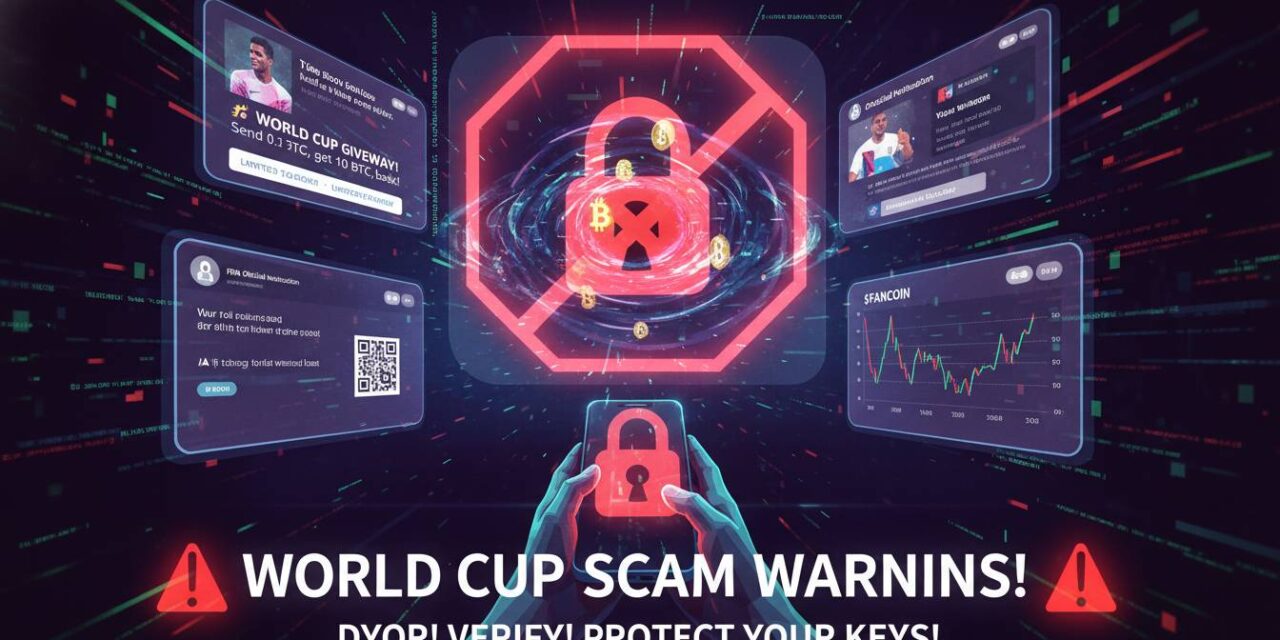
- FBI warns of increasing fake FIFA websites targeting millions of fans ahead of the 2026 World Cup.
- Bitdefender identified over 55 active phishing campaigns exploiting World Cup hype to steal personal information.
- Scammers use typo-squatting and malicious ads to deceive fans into providing sensitive data and cryptocurrency.
- Law enforcement urges fans to verify URLs and report suspicious activity to the Internet Crime Complaint Center.
This article is for informational purposes only and does not constitute financial or investment advice. Cryptocurrency markets are highly volatile. Always do your own research before making any investment decisions.
According to the FBI, fake FIFA websites are proliferating ahead of the 2026 World Cup, targeting millions of soccer fans with crypto scams designed to steal personal information and sell bogus tickets, merchandise, and streaming access. Bitdefender’s researchers identified over 55 active phishing campaigns using fraudulent domains and aggressive social media ads to imitate FIFA branding, an escalation as the event hosted in the United States, Canada, and Mexico nears. Law enforcement warns that cybercriminals employ domain impersonation and typo-squatting, urging fans to verify website URLs before entering any details or sending crypto. These scams exploit World Cup hype, making vigilance and cybersecurity awareness a top priority for 2026. Cybercrime adapts as tournament anticipation builds.
NEWS IN PHOTOS:
Fans at World Cup festival zones in Seattle, New York, and Mexico City now encounter enhanced digital security, with Komonews capturing law enforcement visible at ticketing entrances.
FBI warning: Fake FIFA websites are multiplying ahead of the 2026 World Cup.
55+ active scam campaigns:Bitdefender researchers found ongoing operations targeting soccer fans.
Personal information at risk: Attackers collect names, addresses, and banking data using replica sites.
Common scam vectors: Includes typo-squatted domains, malicious ads, “ticket” offers.
Geographic spread: Fraudulent sites target fans across the US, Canada, and Mexico.
Precautionary measures: The FBI urges all fans to verify URLs and report suspicious activity.
Fake FIFA sites target World Cup fans
These malicious portals closely imitate FIFA’s branding, logos, and interface to deceive visitors, the agency notes. Domain registration strategies include typo-squatting — like substituting “fiffa[.]com” or switching to .org from .com — to catch careless typists. The FBI anticipates a surge of additional fake domains as the World Cup approaches, with new sites launching both before and throughout the month-long tournament.
Southfloridareporter documents rising scam activity through phishing emails, social media messages, and paid advertisements rerouting users to counterfeit FIFA portals. According to the FBI, the main motive is to collect names, addresses, phone numbers, email credentials, and bank account details.
The security provider warns the phishing portal network continues to expand as cyber teams rapidly replicate sites and scale up pay-per-click social ad buys. Sites appear, vanish, and re-spawn briskly to evade takedown, overwhelming some fans. According to the FBI’s guidance, anyone who thinks they may have submitted information to a fake FIFA site is strongly encouraged to report to the Internet Crime Complaint Center at ic3.gov.
Bitdefender research emphasizes a broader football scam ecosystem
Bitdefender’s 2026 research documented over 55 active scam campaigns specifically targeting football fans through fake online shops, malicious social media ads, IPTV piracy offers, and fraudulent crypto “investment” schemes. According to Bitdefender, attackers don’t just create websites — they exploit trending hashtags, message board posts, and viral group chats to amplify reach in real time.
Bitdefender reports that advertising budgets for these campaigns are spent on highly targeted platforms like Facebook and Instagram, raising the odds of tricking unwary fans. Users clicking these ads are redirected to phishing landing pages requesting payment in Bitcoin or Ethereum, then lose access or product once cryptocurrency is sent. According to the cybersecurity team, IPTV piracy operations are among the fastest-advancing offers. Fans pay for “official” World Cup live streams but receive nothing, or the streams are quickly shut off after payment.
Southfloridareporter verifies that FIFA team brands and even organizers’ committee names remain attractive targets. Attackers refine domain impersonation strategies, deploying dozens of near-lookalike sites before big days like ticket releases and lineup announcements. Millions of casual fans converge online, and even a small percentage falling victim yields big numbers. Bitdefender anticipates scam sophistication to rise, with more realistic templates, advanced login traps, and automated payment processors. Industry experts warn the World Cup window will be the most targeted yet.
Why sporting events attract scammers
According to Cybersecurity Insiders, mass-audience events such as the World Cup are prime environments for cybercrime. Spikes in web traffic, distracted audiences, and the abundance of valuable data attract fraudsters seeking easy access. Organizers channel millions of supporters to high-traffic ticket and merchandise portals. As a result, official-looking spoof sites or typo-ridden domain traps reach huge numbers in a short amount of time. Per Bitdefender, attackers typically register dozens of domain lookalikes in advance of ticket drops or player announcements — ready to intercept fans searching for genuine news.
Each click and transaction provides criminals a chance to gather high-value personal information, process quick sales, or plant malware for other schemes. Law enforcement officers track spikes in complaints and fraudulent domain registrations around every football championship. criminals cycle new infrastructure for every main event, evading detection with temporary websites and burner contact details.
How football fans can stay safe
Per FBI recommendations, the most reliable defense against World Cup crypto scams is vigilant, basic cyber hygiene. Always check that a FIFA-related website’s URL matches exactly “www.fifa.com”. Even a small typo or an unusual domain ending should be a red flag. Avoid clicking any link from unsolicited emails, texts, or paid social ads offering tickets, VIP packages, or “official” streaming access. Navigate directly to the official page. According to Komonews, scammers now launch sponsored direct messages and urgent, legit-looking advertisements as the first attack step.
⚠️The #FBI is warning the public that cyber criminals are conducting spoofing attacks against FIFA websites in advance of the 2026 World Cup. Their goal: to collect personally identifiable information entered by users to sell fake World Cup tickets & hospitality products, & to… pic.twitter.com/9bIbqA2cVAView on X
Southfloridareporter advises extra caution for any ticketing or merchandise request that wants payment in cryptocurrency — especially if the wallet address isn’t verified by an official entity. FIFA and its partners do not accept Bitcoin, Ethereum, or other digital currencies for sales.
The FBI encourages scam victims or anyone suspecting an attempted scam to file a report at the Internet Crime Complaint Center immediately. Fast reporting lets agencies coordinate investigations and take down campaigns faster. Law enforcement also recommends fans watch their bank and credit accounts, since even minimal personal details submitted to phishing sites can spark a wider identity theft episode.
June 1– United States, Canada, and Mexico confirmed as joint World Cup hosts; Komonews and Bitdefender warn of concurrent scam spike.
June 2– FBI Public Service Announcement distributed, urging increased caution for soccer fans and online purchasers.
June 3– Bitdefender draws attention to over 55 active scam campaigns targeting World Cup fans through fake stores, IPTV offers, and phishing links.
June 4– Southfloridareporter emphasizes domain impersonation using “fiffa[.]com” and alternative extensions like “.org”.
June 5– FIFA’s organizing committee reminds participants to ignore unsolicited messages or any crypto-related purchase requests.
Leaving World Cup Crypto Scams in June 2026
Several counterfeit FIFA domains and shell scam stores have been flagged and removed thanks to reporting by the FBI and collaborative partners.
Law enforcement anticipates taking down more than a dozen IPTV- and crypto-related scam sites during June 2026.
Major social media platforms launched new anti-scam filters for World Cup-branded ads after the June 2 alerts.
According to Bitdefender in June 2026, cybercriminals are raising both their technical sophistication and the scope of fraud efforts involving football and cryptocurrency. Komonews reports coordinated moves by law enforcement agencies worldwide — as the World Cup’s buying season begins, more agencies are sharing databases and tracking new scam domains in real time.
For deeper technical coverage, readers can visit More World Cup Crypto Scams analysis and forecasts.
Soccer fans, event organizers, or media professionals with ongoing concerns about trending scam models or technical insights can connect via Get coverage on World Cup Crypto Scams and upcoming market trends for further information. Community awareness and prompt reaction are the best defenses as the World Cup draws millions of eyes — and would-be scammers — online.
On Google, tick the box next to stnews.live to see our reporting higher in Top Stories.
Disclaimer: The content on this page is for informational purposes only and does not constitute financial advice. Always do your own research before making investment decisions.

Elena Petrova is STnews's Regulation Correspondent, reporting on MiCA, SEC and CFTC actions, the FATF travel rule and AML/KYC developments across digital-asset markets. Her coverage adheres to STnews's editorial standards — primary-sourced, cited, and non-advisory.
Conflicts of interest
I have no current legal practice or retainer relationships with any cryptocurrency company. Past employment relationships are listed publicly.