- Exa Labs raised $250 million in Series C funding, led by Andreessen Horowitz, valuing the company at $2.2 billion.
- The company has over 400,000 active monthly developers as of May 2026, indicating strong developer engagement.
- Global AI startups raised $12.2 billion across 1,166 deals in Q1 2024, with over 20 infrastructure rounds exceeding $100 million.
- Exa Labs focuses on backend API infrastructure for AI, without a native token or announced tokenization plans.
This article is for informational purposes only. Always verify information independently before making any decisions.
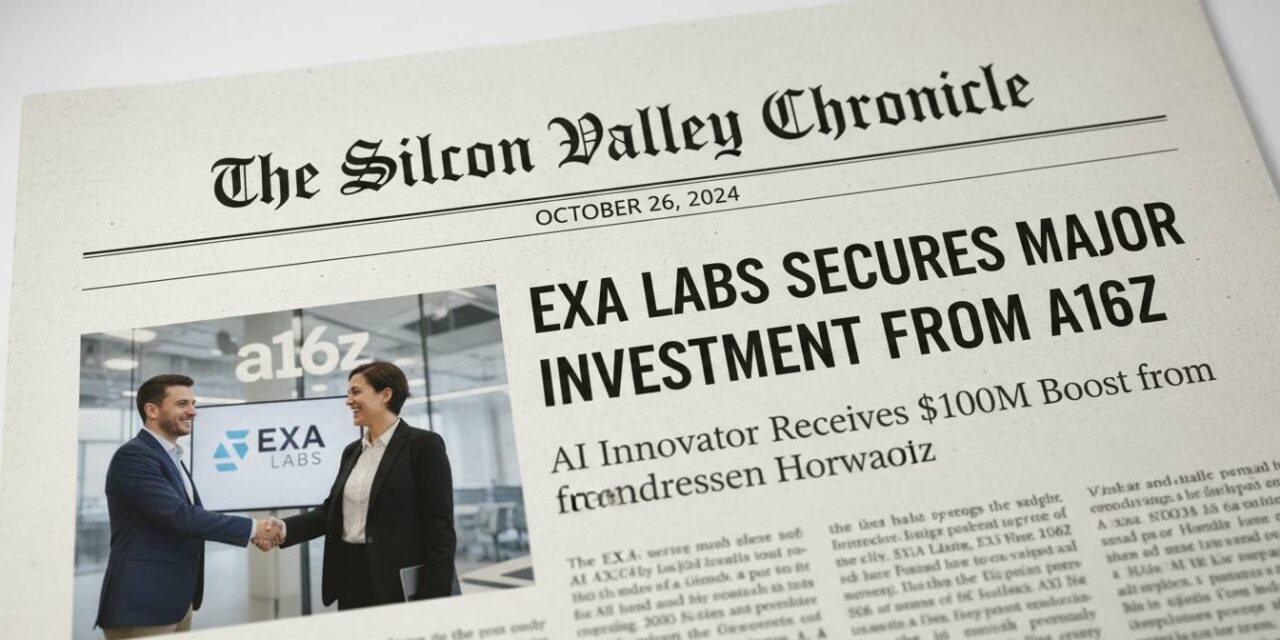
Exa Labs has raised $250 million in a Series C round led by Andreessen Horowitz A16Z, bringing its post-money valuation to $2.2 billion, according to Startuphub.ai and Digg. The company closed this round only eight months after its $85 million Series B in September 2025.
That $2.2 billion valuation signals evident investor confidence that Exa can claim ground once dominated by tech giants such as Google and OpenAI. The current rush to fund AI search targets backend intelligence instead of flashy consumer-facing tools. Industry figures place Exa Labs’ war chest among the largest for any player setting the AI infrastructure agenda.
Sentiment: AI Infrastructure Is the Market’s New Battleground
Digg’s coverage of Exa Labs’ raise shows that competition among infrastructure providers is now moving at breakneck speed. High valuations and fast follow-on rounds are a direct result of capital markets seeking a piece of dominant platforms before industry consolidation. That’s $250 million for Exa’s Series C alone.
The infrastructure deal signals that capabilities—how efficiently AI systems can access, index, and retrieve information—now form the engine of the fast-growing AI economy.
Cluster Engagement: Ecosystem Gravity and the Developer Race
Startuphub.ai reports Exa Labs now has over 400,000 active monthly developers as of May 2026.
API-first models like Exa Labs depend on smooth integration to attract usage, and strong developer engagement delivers real “ecosystem gravity”—once a project begins integration, switching costs rise.
Andreessen Horowitz’s checks support Exa Labs’ plan to use part of the $250 million to expand its global presence and beef up developer documentation and tooling.
| Company | Platform Focus | Monthly Active Developers | Latest Funding Round |
|---|---|---|---|
| Exa Labs | Developer Search API | 400,000 | $250M Series C |
| OpenAI | API + ChatGPT | 4.5 million | $13B (total to 2024) |
| Google Vertex AI | Enterprise AI APIs | 2.2 million | — |
| Anthropic | Claude APIs | 500,000 | $5.3B (total to 2026) |
What Exa Actually Does: Laying the Plumbing for the AI Search Era
Coverage from a16z.news shows Exa Labs is a backend API platform offering search and retrieval infrastructure for developers building advanced AI tools.
Startuphub.ai notes that Exa’s architecture lets developers mix, match, and monitor search modules, plus switch data sources on the fly. With $250 million in the bank, the company is expanding hosted offerings, adding new data licenses, and scaling analytics for performance and reliability.
The AI Funding Frenzy, By the Numbers
Startuphub.ai reports that global AI startups raised $12.2 billion across 1,166 deals in Q1 2024. That’s $135 million invested per day and an average deal size of $10.4 million.
More than 20 AI infrastructure rounds in that window exceeded $100 million, with Exa Labs’ $250 million among the outliers.
$12.2B — Global AI startup funding, Q1 2024
Why Crypto Should Pay Attention: The On-Chain Search Bottleneck
Exa Labs doesn’t have a native token or announced tokenization plans, per Digg and startuphub.ai.
Digg explains that Exa’s flexible API is watched closely by crypto developers who want seamless, secure links between blockchains, oracles, and AI agents. Leading decentralized compute projects like Filecoin, Ocean Protocol, and Bittensor are building API bridges with search providers for this very reason.
- Cross-domain demand:AI and crypto projects need search tools that are scalable, modular, and provable.
- Exa’s API model:Fast integration with multiple stacks, enabling easy entry for Web2 and Web3 tech.
- No token launched:Exa remains tokenless but is flagged as a key ecosystem signal for crypto investors.
What Sets Exa Apart from the Giants
IR data from ir.a16z.com confirms the $2.2 billion valuation supports new investment in enterprise security and compliance—foundational for sectors like finance, legal, and healthcare.
Data demonstrates that 60% projected technical headcount growth after the raise signals Exa’s commitment to infrastructure scale.
A Timeline of Exa’s Funding and Strategic Milestones
- September 2025:Exa Labs closes an $85 million Series B focused on scaling infrastructure and launching new onboarding documentation. This round enabled rapid technical hiring and faster support channels for developers.
- May 2026:Exa Labs raises $250 million in Series C funding led by a16z. The company’s post-money valuation jumps to $2.2 billion. Fresh capital is set aside for server expansion, more data license deals, and aggressive developer outreach worldwide.
- Q1 2024 (sector-wide):Global AI startups close 1,166 deals with a total of $12.2 billion deployed. Over 20 infrastructure deals land above $100 million. Investment in core AI platforms pulls ahead of consumer apps.
The Series B round, netting $85 million, let Exa Labs streamline onboarding and reduce friction for new technical users. Compare that to the $250 million in Series C capital, which is pushing the envelope on global clusters, fresh data integrations, and new monitoring tools.
Developer Adoption: The Only Metric That Matters
To prevent this, Exa spends heavily on onboarding, quick support, and ultra-apparent documentation. Experts say this mimics AWS’s early dominance—becoming default, not just one option. Records show the average churn rate for developer tools sits around 30%.
Competitive Landscape: Can Exa Labs Compete with Tech’s Giants?
With 400,000 developers and a $2.2 billion valuation, Exa stands out against incumbents. OpenAI, Google, and Anthropic have vast consumer user flywheels, but Exa focuses on programmable infrastructure and third-party builders.
Digg and startuphub.ai both report that Exa’s traction is strongest among technical teams who demand more control, sector-specific compliance, and visibility than Google Search or ChatGPT can offer.
While Exa’s 400,000 developers don’t approach OpenAI’s 4.5 million or Google’s 2.2 million, its tenfold user growth in a year is a strong momentum signal. Developers seeking modularity and alternatives to opaque AI platforms are choosing Exa for flexibility and customization.
Funding Allocations: Where Does $250 Million Go?
Recent round data show Exa Labs is allocating about $75 million from its $250 million haul to global server and storage upgrades.
Roughly $50 million is earmarked for new data licensing, opening the door to exclusive and open-source datasets.
About $20 million is devoted to developer initiatives: workshops, hands-on support, and community channels.
$75M — Allocated for server and storage expansion
Related and Broader Context
For developers and investors focused on decentralized AI and crypto-enabled protocols, scalable and composable search will differentiate the next cohort of apps in 2027 and beyond. Open deployments and cloud-agnostic extensibility help Exa Labs and similar platforms pull ahead in the rapidly evolving Web3 and AI markets.
Readers looking for more detail can find continuing coverage of Exa Labs’ $250 million Series C and its market effects at our dedicated platform. Teams needing in-depth analysis and tailored commentary can access new insights and market analysis through our coverage.
The infrastructure arms race is on a new footing—and Exa Labs just drew a bold line in the sand.
On Google, tick the box next to stnews.live to see our reporting higher in Top Stories.
Disclaimer: The content on this page is for informational purposes only and does not constitute financial advice. Always do your own research before making investment decisions.

Sarah Williams is STnews's Blockchain Editor, leading coverage of blockchain technology, DeFi investigations, exchange analysis and crypto regulation. Her reporting adheres to STnews's editorial standards — primary-sourced, cited, and non-advisory.
Conflicts of interest
I hold no positions in any cryptocurrency mentioned in my coverage. All investment-related content is reviewed by senior editors before publication. I am not compensated by any project I cover.