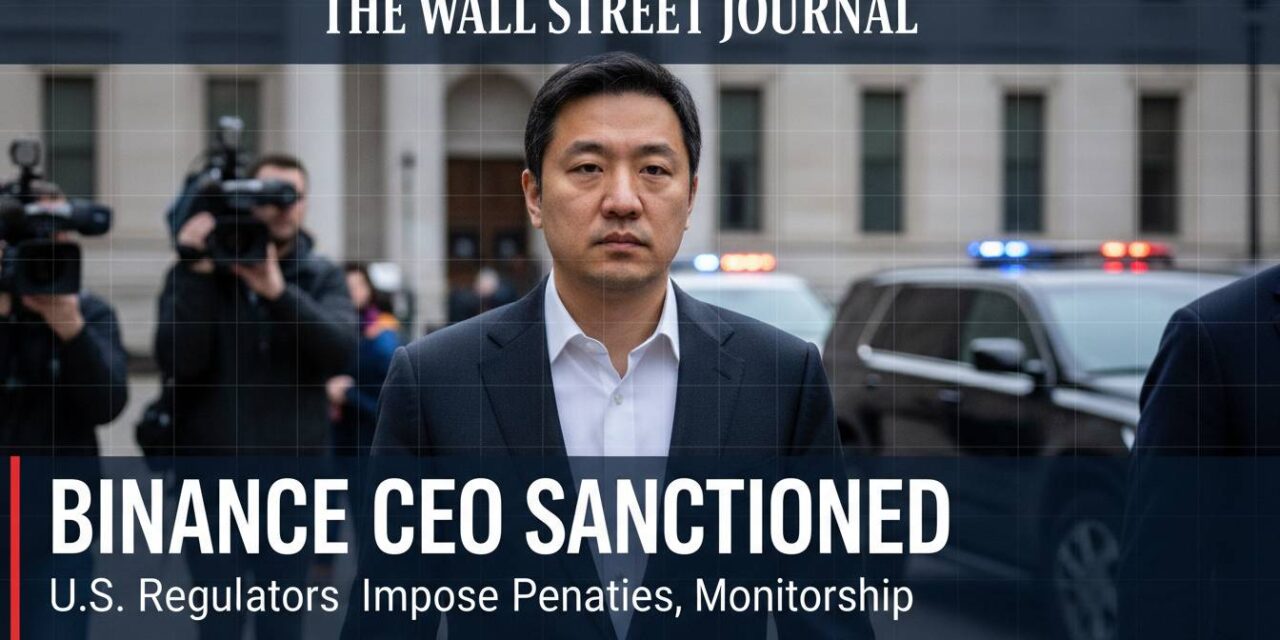
- Binance CEO Richard Teng dismissed WSJ allegations of sanction violations, stating the claims are "false and defamatory."
- Binance blocked over $4 billion in suspicious transactions and cooperated with law enforcement in over 70 countries since 2021.
- U.S. Senate opened an investigation into Binance's operations, requiring compliance records by June 15, 2026.
- Binance controls 41% of global spot crypto trading volume, processing over $22 billion daily.
This article is for informational purposes only. Always verify information independently before making any decisions.
According to newly published coverage in the Wall Street Journal, Binance enabled trades for users in sanctioned jurisdictions, with Iran specifically named in the investigation. Binance CEO Richard Teng dismissed the article as misleading, branding the allegations as skewed and insisting Binance had no tolerance for sanction violations.
CoinDesk reports that Binance blocked more than $4 billion in suspicious transactions and cooperated with law enforcement in over 70 countries since 2021. That record stands out among traditional financial institutions facing similar oversight, Research note, showing that Binance operates under continuous government scrutiny. The company says it applies stringent transaction monitoring and Know Your Customer rules well beyond minimum requirements, forwarding suspicious transaction reports to authorities as needed.
BNBUSD Chart: Market Reaction to WSJ Report
Trading Volume
According to spot market data, BNB recovered from $515 on April 18 to $604 on May 21—a rally equating to 17% in less than five weeks. According to Halesbook, trading volume passed $1.2 billion on days of heightened volatility, as the WSJ report forced traders to reassess BNB’s risk profile and the exchange’s operational health.
Volatility Metrics
Intraday volatility surged to 58% in mid-May—more than double March’s average.
Latest News: Binance’s Legal and Compliance Push
According to the official May 20 statement, Richard Teng rejected the WSJ’s allegations of sanctions circumvention, emphasizing in public communications that Binance’s monitoring systems thoroughly vet all user activity for global Anti-Money Laundering and KYC compliance.
🚨BINANCE PUSHES BACK ON WSJ ALLEGATIONSView on X
Binance CEO Richard Teng calls the report “false and defamatory,” denying claims it fired investigators over concerns about funds linked to sanctioned Iran-related entities. pic.twitter.com/w2m0TJ7KkD
According to Halesbook, Binance has considered legal proceedings against the Wall Street Journal, stating the claims were “defamatory and without substantiation.” A lawsuit under consideration would pursue both monetary damages and court orders to protect the exchange’s reputation across multiple international jurisdictions.
More News from Cointelegraph: Outflows and Industry Impact
According to Cointelegraph, more than $960 million in digital assets flowed out of centralized crypto exchanges industrywide during the 48 hours following the WSJ report on Binance.
https://t.co/quXoGEunsLView on X
Private exchanges, wallet providers, and non-custodial gateways saw a pronounced spike in new user registrations during this window. Many market participants now prioritize self-custody in the wake of news-driven concerns, per Cointelegraph.
Binance Rejects WSJ Allegations: Compliance Figures and Procedures
According to Halesbook, Binance’s compliance team reviewed over 90,000 customer accounts flagged for risk signals between January 2023 and April 2026. That review resulted in 3,400 permanent suspensions tied to potential sanctions violations, and the company says it regularly updates screening protocols. The figures affirm that Binance maintains data-driven enforcement, submitting Suspicious Activity Reports to the relevant authorities after investigatory checks.
Binance’s internal controls operate with compliance tools described as matching or exceeding traditional finance standards, per Halesbook and Coincentral.com. KYC measures leverage AI-driven analysis, flagging exposure to sanctioned jurisdictions and monitoring on-chain wallet typologies. Binance updated its controls in May 2024, focusing new resources on AI-enhanced risk monitoring for high-risk regional flows. With over 4 billion transactions monitored in three years, Binance aims to demonstrate that its systems can filter out nearly all illicit user intent.
According to Binance Rejects WSJ Allegations Over Sanctions Compliance, Binance has redoubled cooperation with governments, sharing reports with more than 70 jurisdictions and supporting global investigations.
Senate Inquiry Raises Compliance Questions: U.S. Political Pressures
Legislative Timeline
According to Coincentral, on May 22, 2026—the day after the WSJ report ran—U.S. Senators on the Committee on Banking, Housing, and Urban Affairs opened a formal investigation into Binance’s operations. The Senate panel issued an explicit deadline of June 15, 2026 for Binance to provide comprehensive internal compliance records and “all correspondence concerning Iranian users.” The scope of the inquiry includes customer vetting data, transaction logs, and specific policies addressing U.S. and global sanctions rules. Every major compliance incident at Binance now triggers public hearings in Washington.
According to Coincentral.com, the committee wants to hear from at least three former Binance compliance officers who left between October 2024 and February 2026. Lawmakers are aiming to assess both the strength of protocol implementation and possible internal disputes or whistleblower claims. Senate sources referenced Binance’s $4.3 billion settlement with U.S.
Media coverage of the committee’s moves, per Coincentral, has prompted other exchanges such as Coinbase and OKX to review their own real-time location monitoring tools and compliance team upgrades.
Binance’s Impact on Crypto Markets: Dominance and Volatility
According to market data published by Cointelegraph, Binance currently controls 41% of global spot crypto trading volume, processing over $22 billion per day. In comparison, Coinbase handles 14% with $7.5 billion, and Kraken follows at 9% and $4.6 billion respectively. Market dominance has ripple effects for price discovery in both Bitcoin and Ethereum as well as major altcoins. Because Binance’s platform hosts a substantial share of order book liquidity, its operational status directly influences price efficiency as well as volatility for all correlated tokens. During the WSJ controversy, Binance Coin (BNB) volatility rose sharply, with a 30-day rolling volatility exceeding 58% in mid-May—more than double March’s baseline.
| Exchange | Global Market Share (%) | Average Daily Volume |
|---|---|---|
| Binance | 41 | $22B |
| Coinbase | 14 | $7.5B |
| Kraken | 9 | $4.6B |
Per Coincentral.com, BNB’s rolling correlation with Bitcoin climbed from 0.61 in March to 0.87 by late May 2026, making Binance’s platform risk a central driver for overall market action. The spike in open interest on Binance’s BNB derivatives contracts signalled a surge in hedging and speculative positioning. Following the WSJ report, order books thinned and price responses to marginal trades intensified—a sign of cautious market making. The industry now treats regulatory headlines as tradeable events with short-term volatility spikes. Price discovery is increasingly shaped by legal news rather than organic demand. Exchanges must plan for periodic, externally induced uncertainty shocks.
Legal Action Considered Against Wall Street Journal: As confirmed by Halesbook, Binance’s leadership considered a multi-jurisdictional defamation suit targeting the WSJ, seeking both monetary compensation and judicial restraints.
Cointelegraph tracked a notable increase in self-custody wallet registrations and hardware wallet purchases. Ledger and Trezor reporting $900 million in related outflows from major centralized platforms in roughly a week.
Coincentral.com reports that rival exchanges OKX and Kraken deployed live location monitoring tools post-Binance headlines to identify jurisdictional sanctions exposure, demonstrating that regulatory scrutiny creates a fast feedback loop for industry-wide compliance.
Timeline of Binance and Sanctions Inquiry (2023–2026)
- April 2023:Binance concluded a $4.3 billion settlement with U.S. regulators for past Anti-Money Laundering violations. This remains the largest single compliance payment in crypto history and set the bar for expectations on future KYC practice upgrades across the sector.
- May 2024:Binance deployed an upgraded compliance protocol using AI-driven risk analysis to catch complex exposure patterns from high-risk locations. Implementation highlighted Binance’s new proactive tech investments for sanctions screening.
- February 2025:The firm suspended hundreds of accounts tied to sanctioned-country phone numbers, gathering comprehensive evidence as part of its internal compliance roadmap. According to internal reporting reviewed by Coincentral, these moves blocked further platform access and led to several self-disclosures to authorities.
- May 18, 2026:The Wall Street Journal published its sanctions allegations, anchoring the story on leaked internal Binance correspondence that, if proven, could suggest intent to bypass certain regulatory strictures. The story triggered full-scale industry and Senate review in under 72 hours.
- May 20, 2026:Binance’s CEO publicly denied all WSJ accusations and signaled intent to defend the company’s reputation in court. The disclosure also pledged expanded cooperation with global enforcement agencies to prove compliance standards held up under external scrutiny.
- May 22, 2026:The U.S. Senate Committee opened a formal inquiry, demanding all internal documentation and a full record of communications related to sanctioned jurisdiction users within three weeks. Lawmakers expect oral testimony under oath from recent former compliance staffers to inform ongoing policy debate.
How Binance’s Defense Shapes Industry Response
After Binance’s fast rejection of the WSJ’s allegations, at least five large centralized crypto exchanges announced a review of their own compliance controls and external audit protocols within two weeks, according to Coincentral.com. Coinbase strengthened its compliance committee, adding two external directors with regulatory and enforcement experience. Major industry advocacy organisations issued a public call for all exchanges to adopt “transparent, verifiable reporting standards,” referencing Binance’s defense and the drama surrounding the compliance debate.
According to Halesbook, the industry’s consensus is shifting towards increased information sharing and a collective framework for risk assessment.
Global Regulatory Landscape in 2026
Cointelegraph reports that 61% of financial regulators in G20 economies now categorise significant centralized exchanges as “key risks” for money laundering and sanctions violations, up from 31% in early 2023. In just six months, France, Japan, Singapore, and the United States each commenced top-to-bottom audits of offshore exchange compliance with new anti-money laundering rules.
According to analysis published by Cointelegraph, total compliance and legal technology spending at leading crypto exchanges will surpass $3.2 billion in 2026—a more than threefold increase from 2022 levels.
Market Sentiment and Investor Behavior: Funding and Volatility Metrics
According to Halesbook, perpetual funding rates for BNBUSD futures pairs dropped negative for the first time since October 2025, hitting an annualized -6.2% on May 20. Traders increased bearish bets and index hedges, bracing for regulatory surprises. Spot BNB volatility reached levels unseen in over a year, with four days of consecutive 7%+ intraday price swings after the WSJ report.
$900M — Outflows to self-custody (1 week post-WSJ report)
What Comes Next for Binance and the Industry
According to Cointelegraph, Binance will expand third-party audits and hold regular compliance briefings with key institutional clients starting June 2026. The exchange aims to double its compliance headcount by year’s end, exceeding 1,700 dedicated staff and raising the bar for tech investment in KYC and sanctions automation. The anticipated Senate Committee findings, expected in July 2026, could rewrite operational conditions for all centralized platforms, not just Binance.
On Google, tick the box next to stnews.live to see our reporting higher in Top Stories.
Disclaimer: The content on this page is for informational purposes only and does not constitute financial advice. Always do your own research before making investment decisions.

Sarah Williams is STnews's Blockchain Editor, leading coverage of blockchain technology, DeFi investigations, exchange analysis and crypto regulation. Her reporting adheres to STnews's editorial standards — primary-sourced, cited, and non-advisory.
Conflicts of interest
I hold no positions in any cryptocurrency mentioned in my coverage. All investment-related content is reviewed by senior editors before publication. I am not compensated by any project I cover.