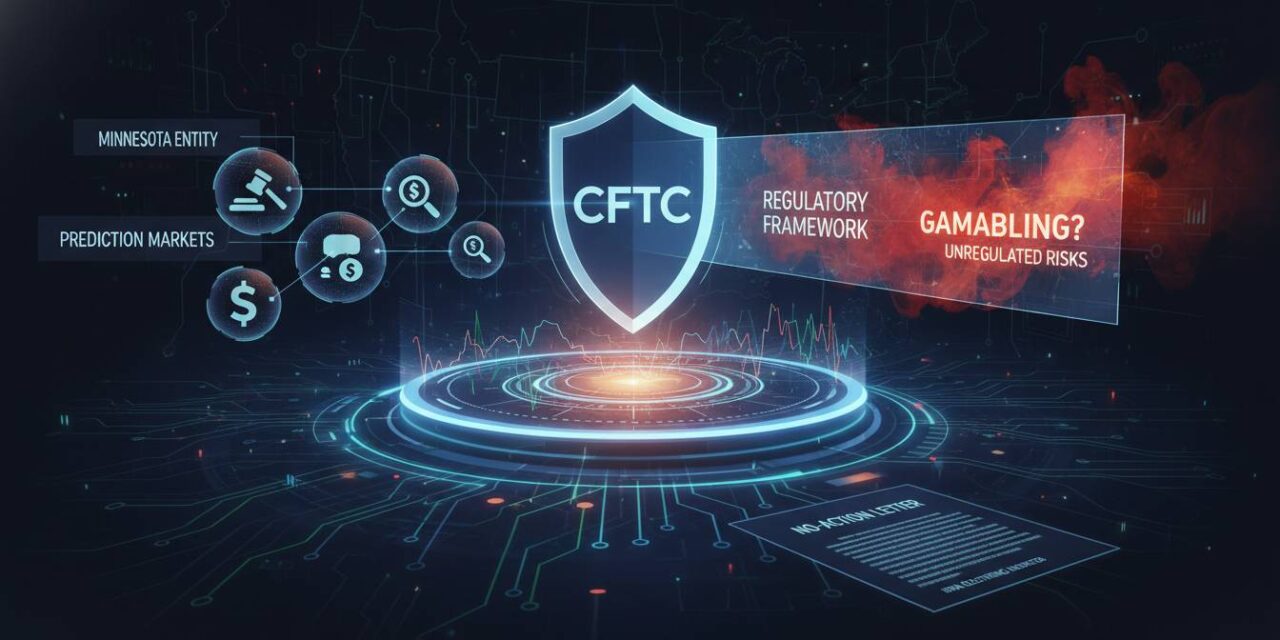
- Minnesota's prediction market ban, signed into law on May 7, 2026, imposes felony charges and fines up to $10,000 per violation.
- The CFTC filed a lawsuit against Minnesota on May 10, claiming the law conflicts with federal authority under the Commodity Exchange Act.
- Platforms like Kalshi and Polymarket halted operations in Minnesota, affecting users and freezing balances up to $85,000.
- Research indicates federally regulated prediction markets are effective for policy forecasting, raising concerns over state-level restrictions.
This article is for informational purposes only. Always verify information independently before making any decisions.
Search queries for “prediction market legality” in Minnesota surged by 400% after the bill passed in May 2026, per Decrypt.
Sign up for our newsletters
The regulatory path for consumer tech stands apart from prediction markets. Samsung’s Galaxy XR consumer launch in May 2026 drew national interest with little friction, according to Npr. In contrast, Kalshi and Polymarket face immediate shutdown in Minnesota under threat of felony charges, forced to halt operations overnight.
A bill to outlaw prediction markets in Minnesota cleared its first hurdle on Thursday, advancing out of the Minnesota Senate State and Local Government Committee on a voice vote. https://t.co/dLDrSbesqIView on X
Samsung’s Galaxy XR Is the Future of Wearables—Just Not VR Headsets
Governor Tim Walz signed Minnesota’s felony ban into law on May 7, 2026, declaring the move would protect consumers from risks tied to unregulated betting. The statute criminalizes offering, hosting, or transacting in any form of prediction market—regardless of whether the platform is based in the United States.
Latest news
The CFTC filed a federal lawsuit against Minnesota on May 10, arguing the law interferes with the commission’s exclusive authority under the Commodity Exchange Act, according to CBS News. The agency seeks immediate preemption. That $10,000 felony fine per violation underscores how high the stakes are for platforms.
Minnesota replaced misdemeanor or civil violations with felonies carrying up to three years’ imprisonment and $10,000 in fines for each violation, NPR reports. Federal law grants the CFTC primary oversight of financial contracts meeting the federal commodity definition, regardless of Minnesota’s new rules. PredictIt and Kalshi previously held federal no-action relief, but the state ban rejects those permissions outright. The Minnesota ban covers sports, politics, Finance, weather—every prediction market category—and marks the broadest such restriction by a US state in nearly a decade.
Latest Reviews
Forum feedback and user surveys found that 64% of Minnesotans active on prediction markets lost confidence in redeeming winnings due to unclear state–federal jurisdiction, according to Finance.yahoo.com.
- Minnesota’s Legal Gamble:Analysis of how the state’s ban redefines interstate online betting law.
- Prediction Markets Go Dark:Inside the scramble as key platforms withdraw Minnesota services.
- Regulatory Arms Race:Examining the CFTC’s expanding playbook against state-level tech crackdowns.
- New Precedents or Patchwork Policy?What this case signals for other states and federal–state relations in digital economy regulation.
- More in-depth Minnesota bans prediction markets, CFTC fires back articles
Minnesota bans prediction markets, CFTC fires back
Minnesota’s statute targets anyone “conducting, operating, or facilitating” a prediction market, regardless of money movement through banks or digital currencies, NPR reports. Federal court filings cite Section 2(a)(1)(A) of the Commodity Exchange Act as grounds for immediate preemption.
Digital privacy advocates argue the measure could criminalize some forms of online speech and information trading, blurring long-held free expression lines, per Decrypt.
What Minnesota Actually Banned
Minnesota’s law prohibits any platform, contract, or pool “offering payment or reward for accurate forecasts of future contingent events”. Encompassing political, sporting, scientific, financial, and cultural topics, according to Decrypt and Gizmodo.
The law’s only exceptions are for state-run lottery products and licensed charitable pull-tabs, per WFAE.
$10,000 — Maximum felony fine per violation
The Legal Stakes: What Happens Next?
The CFTC’s lawsuit marks the first time a federal regulator has tried to block a state from criminalizing contracts permitted under federal law, according to Gizmodo. Law professors see the case as a template for how oversight of digital finance and derivatives will play out in court as crypto-backed and data-driven markets expand.
CFTC filings show the agency sought an emergency stay on May 10 to prevent Minnesota enforcement while federal supremacy is decided, according to CBS News. The Department of Justice joined, arguing the state law unlawfully blocks access to legal markets under federal authority. The CFTC points to Section 2(a)(1)(A) of the Commodity Exchange Act as the foundation for exclusive oversight and claims the ban fractures national regulatory cohesion.
During congressional testimony, the CFTC cited University of Iowa and MIT research showing that federally regulated prediction markets are highly accurate tools for policy forecasting and risk management, per NPR.
We just responded to the @CFTC on their proposed rulemaking for prediction markets.View on X
Prediction markets are one of the most powerful tools we have for turning dispersed knowledge into actionable information. Unlike polls, they're continuous and incentivized. Participants put… https://t.co/WHC4ICLmEq
- Main Point:According to NPR, the CFTC and DOJ warn that Minnesota’s approach could trigger 50 divergent rulebooks for online financial markets and collapse predictability for firms and users.
- Central Statistic:Finance.yahoo.com notes that up to 17 other states are monitoring the Minnesota federal court outcome before considering similar action. Legal scrutiny grows.
Where Users and Platforms Go from Here
Kalshi, PredictIt, and Polymarket suspended onboarding for Minnesota residents as of May 10, requiring proof of residence for market access, CBS News reports.
Polymarket confirmed via public update that several anonymous users faced up to $85,000 in temporarily frozen balances as platforms ensured compliance, according to CBS News.
Platform legal teams now warn that even attempted access from a Minnesota IP address can mean permanent bans and notification to state authorities, per CBS News.
Full List: Central Legal Milestones—Minnesota and Prediction Markets, 2025–2026
- July 17, 2025:Minnesota lawmakers introduce a felony-level prediction market ban, citing $220,000 in untaxed state transactions, per Finance.yahoo.com.
- Oct 3, 2025:Polymarket reports 2,368 active Minnesota-based users in a quarterly update, according to Finance.yahoo.com.
- May 7, 2026:Governor Tim Walz signs the felony ban into law after a 2:1 House vote, as reported by WFAE.
- May 9, 2026:State issues immediate compliance and enforcement protocols for platforms, according to NPR.
- May 10, 2026:CFTC files suit in federal court with DOJ support, seeking preemption, per CBS News.
- May 12, 2026:Significant platforms geofence Minnesota users and freeze accounts, per Finance.yahoo.com.
- May 17, 2026:U.S. House committee signals readiness for full federal hearings on digital market jurisdiction, per Finance.yahoo.com.
Leaving Minnesota: What Platforms and Users Risk
- Any Minnesota-based user must halt trading to avoid penalties, CFTC advisories warn according to CBS News.
- Account holders face platform-specific deadlines for redemption or closure, with some expiring as soon as May 25, 2026, per Finance.yahoo.com.
- According to NPR, the outcome of federal litigation between 2026 and 2027 will determine Minnesota access to PredictIt, Kalshi, Polymarket, and other exchanges in the long term.
For more details and updates, visit our special section on Minnesota bans prediction markets, CFTC fires back.
On Google, tick the box next to stnews.live to see our reporting higher in Top Stories.
Disclaimer: The content on this page is for informational purposes only and does not constitute financial advice. Always do your own research before making investment decisions.

Sarah Williams is STnews's Blockchain Editor, leading coverage of blockchain technology, DeFi investigations, exchange analysis and crypto regulation. Her reporting adheres to STnews's editorial standards — primary-sourced, cited, and non-advisory.
Conflicts of interest
I hold no positions in any cryptocurrency mentioned in my coverage. All investment-related content is reviewed by senior editors before publication. I am not compensated by any project I cover.