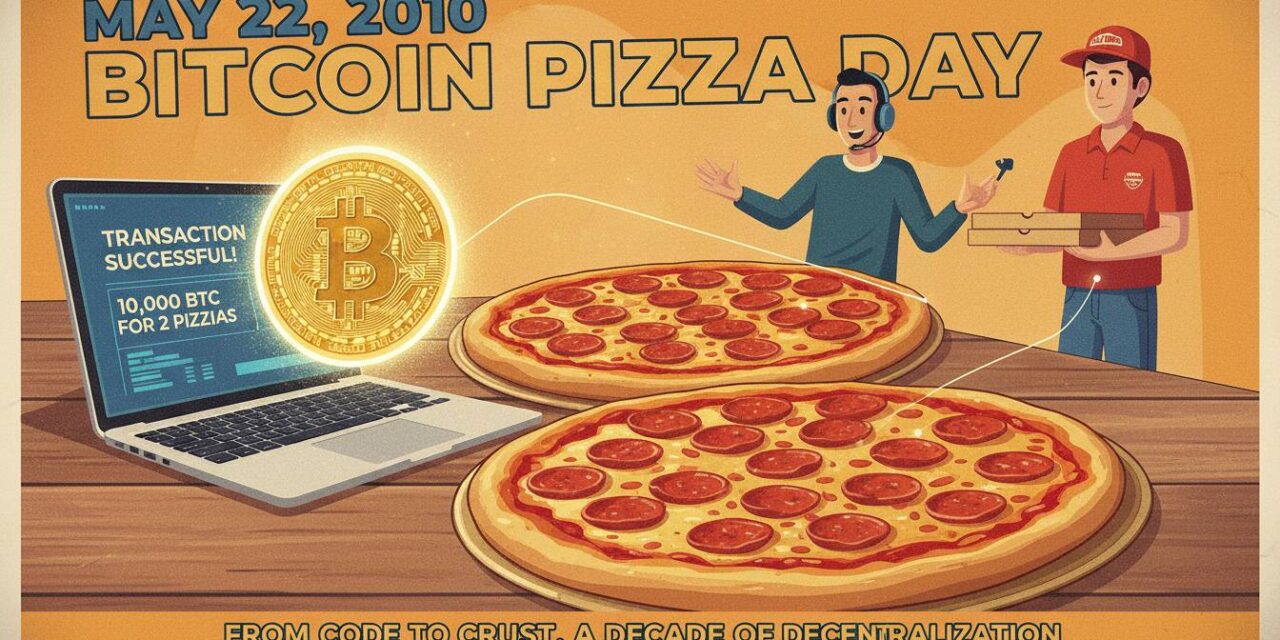
- Bitcoin Pizza Day is celebrated on May 22, marking the first real-world purchase with Bitcoin in 2010.
- Laszlo Hanyecz traded 10,000 BTC for two pizzas, valued at approximately $41 at the time.
- By 2026, the same 10,000 BTC is projected to be worth around $650 million at $65,000 per coin.
- The event highlights Bitcoin's utility and serves as a lesson in opportunity cost for investors.
This article is for informational purposes only. Always verify information independently before making any decisions.
The Legacy and Impact of Bitcoin Pizza Day. On May 22, enthusiasts across the globe celebrate Bitcoin Pizza Day—marking the first real-world purchase with Bitcoin. Bitcoiners recognize May 22 as the day Laszlo Hanyecz traded 10,000 BTC for two pizzas in 2010, providing the first concrete proof that Bitcoin could function as a peer-to-peer digital currency in practice.
$650 million — 2026 value of 10,000 BTC
The 10,000 BTC used for those pizzas—originally valued at roughly $41—would be worth over $650 million at a 2026 price of $65,000 per coin.
Bitcoin Pizza Day is commemorated every May 22 to honor the 2010 transaction when Laszlo Hanyecz, a Florida-based software developer and miner, bought two large Papa John’s pizzas for 10,000 BTC. This purchase marked the first occasion Bitcoin was exchanged for something tangible outside of digital circles, closing the gap between theory and use. Hanyecz posted his offer on the Bitcointalk forum, asking if anyone would take 10,000 BTC in exchange for two pizzas—ushering in a new paradigm for economic interaction online.
In 2010, Bitcoin’s circulating supply stood around a few million coins. But even with 10,000 BTC representing just a sliver of supply, the entire deal amounted to $41 at prevailing rates, per market data cited by Phemex.
By 2026, at mainstream adoption levels, the same 10,000 BTC fetches about $650 million.
FAQ
- When is Bitcoin Pizza Day celebrated?— May 22, annually.
- Why is it called Pizza Day?— It marks the first recorded Bitcoin purchase of a physical item: two pizzas, as confirmed by What Is Bitcoin Pizza Day and phemex.com.
- Who bought the pizzas?— Laszlo Hanyecz, a Florida software developer and early Bitcoin miner.
- How many Bitcoin did it cost?— 10,000 BTC, worth about $41 in 2010.
- How much are those coins worth now?— In May 2026, 10,000 BTC equals nearly $650 million at $65,000 per coin.
- Is Pizza Day an official holiday?— It isn’t a legal holiday, but the date is embedded in crypto community calendars worldwide and widely marked by exchanges and digital asset groups.
- How do people celebrate?— Celebrations include pizza parties, giveaways, themed promotions, and charity campaigns in both physical and online spaces.
- Is Laszlo Hanyecz still involved in Bitcoin?— According to phemex.com, Hanyecz stayed active in the cryptocurrency world for years, regularly reflecting on his unique role as Bitcoin’s first commercial user.
The Transaction That Started It All
The saga began May 18, 2010, when Hanyecz posted an offer in the Bitcointalk forum: 10,000 BTC for two considerable pizzas, delivered to his home in Jacksonville, Florida. Four days later, fellow forum member “jercos” accepted and had two Papa John’s pizzas delivered, kicking off the first verifiable exchange between Bitcoin and the tangible world.
At less than $0.005 per coin, the total outlay for the pizza came to about $41.
Why Pizza Day Still Matters in 2026
Modern exchanges and wallet companies use Pizza Day to enroll new users—through bonuses, tutorial events, or themed blockchain demos. The Giving Block, a platform specializing in crypto philanthropy, reports that Pizza Day often doubles as a global giving day.
Charitable use cases now dominate Pizza Day promotions. According to The Giving Block, several hundred nonprofits use the event to explain the benefits of Bitcoin giving, reaching fresh donors and amplifying ongoing campaigns.
The Numbers Behind the Legend
On May 22, 2010, 10,000 BTC equaled less than $50. Fast forward to 2026: the same stash would command roughly $650 million at a $65,000/BTC spot price. The Pizza Day haul, while trivial in 2010, now headlines every discussion of opportunity cost and exponential returns in technology—turning a minor whim into a running lesson for every investor.
A study published by a research organization shows not only did Hanyecz’s buy introduce the public to Bitcoin’s utility. It now exemplifies the unpredictable—and sometimes shocking—value that new technologies can unlock as their use cases mature. Few imagined a $41 order could become world-famous, anchoring the annual celebration of a new monetary era.
| Year | BTC Price | 10,000 BTC Valuation |
|---|---|---|
| 2010 | $0.004 | $41 |
| 2014 | $600 | $6,000,000 |
| 2018 | $8,000 | $80,000,000 |
| 2022 | $30,000 | $300,000,000 |
| 2026 | $65,000 | $650,000,000 |
data show that Bitcoin’s journey from $0.004 to $65,000 reflects both the asset’s volatility and its extraordinary growth trajectory.
How the Industry Celebrates
The industry’s top exchanges, wallets, and merchant partners plan large-scale events for Bitcoin Pizza Day.
The Giving Block details how nonprofit groups run campaigns to turn online enthusiasm into real-world impact.
Prominent Pizza Day events in recent years include:
- Exchange pizza deals:Trading a set volume of BTC or other coins earns users pizza vouchers or themed collectibles.
- Charity drives:Platforms like The Giving Block funnel Bitcoin donations into impactful, transparent fundraising for hospitals, education, and crisis response.
- Online contests:Memes, pizza-eating live streams, and photos battle for crypto prizes via Twitter, Reddit, and Discord.
- Developer retrospectives:Forums host debates on the significance of the event, often paired with technical hackathons and whitepaper readings.
- Merchant partnerships:Pizza chains in meaningful cities roll out Bitcoin payment options and discount codes, growing real utility and media coverage.
Trader Lessons from Pizza Day
Bitcoin Pizza Day stands as the ultimate lesson in opportunity cost. Laszlo Hanyecz’s legendary purchase—now worth over $650 million—reminds traders how holding or spending a volatile, high-potential asset can shape outcomes for decades. Early Bitcoiners balanced immense risk against even greater uncertainty, driven by a desire to prove real use and encourage others.
The annual retelling fosters discipline in risk management, adaptability, and patience. Price volatility isn’t a flaw but a feature of new financial technology, and every Pizza Day reminds participants that innovation comes with both pain and reward.
| Detail | Insight |
|---|---|
| Opportunity cost | The true cost of an action isn’t apparent until years later. |
| Proof of utility | Using an asset—rather than hoarding it—can drive network adoption and value. |
| Risk discipline | Volatility is the trade-off for early participation in financial disruption. |
The legend of Pizza Day persists because it’s honest about risk and reward, pain and potential. Every year, it anchors a shared discussion about making decisions amid uncertainty and serves as a reminder that even the smallest acts can shape a movement.
The Enduring Value of Bitcoin Pizza Day
In 2026, institutional capital allocators with billions at stake still cite Pizza Day as the proof point for how user demand, incentives, and network effects fuel monetary innovation.
That $41 order now inspires every new builder, educator, and buyer.
For readers hungry to learn more about Bitcoin’s legacy, see in-depth What is Bitcoin Pizza day? articles for expanded context, expert commentary, and broader lessons on blockchain, finance, and innovation. Anyone wishing to share a Pizza Day moment or suggest a new angle can contact us for more coverage on What is Bitcoin Pizza day?
On Google, tick the box next to stnews.live to see our reporting higher in Top Stories.
Disclaimer: The content on this page is for informational purposes only and does not constitute financial advice. Always do your own research before making investment decisions.

Sarah Williams is STnews's Blockchain Editor, leading coverage of blockchain technology, DeFi investigations, exchange analysis and crypto regulation. Her reporting adheres to STnews's editorial standards — primary-sourced, cited, and non-advisory.
Conflicts of interest
I hold no positions in any cryptocurrency mentioned in my coverage. All investment-related content is reviewed by senior editors before publication. I am not compensated by any project I cover.