





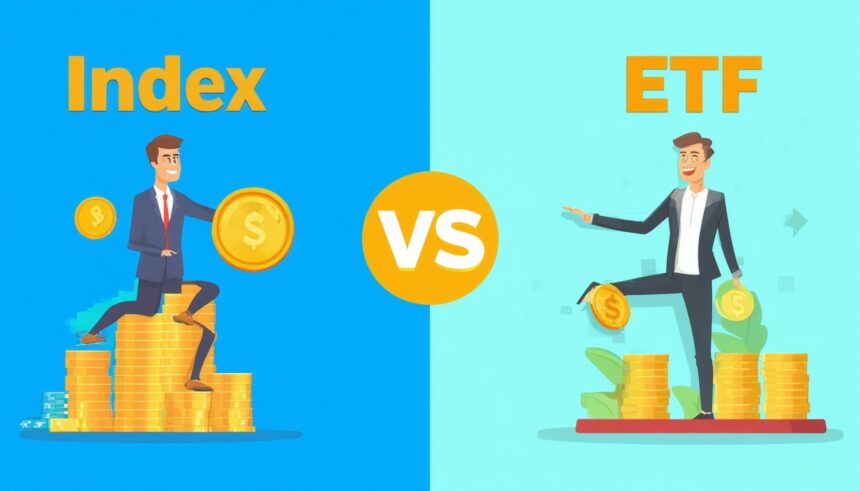
Deciding between index funds and ETFs (exchange-traded funds) has become one of the most common dilemmas for individual investors. Both have fueled the rise of passive investing, offering a simple path to diversified market exposure and generally lower fees than traditional mutual funds. However, their differences in trading flexibility, cost structure, and tax efficiency can make one better suited than the other, depending on your goals and investing style.
As passive investing cements itself in both retail and institutional portfolios, understanding the subtle distinctions between index funds and ETFs has never been more crucial. Making an informed choice can have a direct impact on your long-term gains and investing experience.
Core Definitions: Index Funds and ETFs Explained
Both index funds and ETFs are pooled investment vehicles tracking a specific market benchmark—like the S&P 500, Nasdaq 100, or a global bond index. The fund manager buys all, or a representative sample, of securities within the target index, aiming to mirror its performance.
Index funds are typically structured as mutual funds. Investors buy or sell shares at the fund’s net asset value (NAV), calculated once at the market close each day.
ETFs, on the other hand, trade on exchanges like individual stocks. Their price fluctuates throughout the day, and they’re bought or sold at the current market price—not just at NAV.
“Index funds and ETFs both serve as vehicles for cost-effective diversification, but the mechanics of access and ongoing management create real differences in investor experience.”
– Sarah Newcomb, PhD, behavioral economist
Key Differences: Index Fund vs ETF
While their basic premise is similar—broad, low-cost exposure—the ways investors interface with index funds and ETFs vary meaningfully.
Trading Flexibility
- Index funds: Traded directly with the fund company at day’s end NAV. Ideal for set-and-forget contributions such as retirement plans (401(k), IRA).
- ETFs: Traded on stock exchanges throughout the day. This allows:
- Intraday buying/selling
- Limit/stop orders
- Potential for margin trading and short selling
Minimum Investment
- Index funds: Often require a minimum investment, which can range from a few hundred to several thousand dollars.
- ETFs: No fund-imposed minimums. Investors buy as little as a single share (plus commission, if any).
Fees and Expenses
Both vehicles are known for low expense ratios relative to actively managed mutual funds, but ETFs can edge out index funds on cost in specific areas:
- Management Fees: Generally similar; both commonly feature annual expense ratios well under 0.25% for major index trackers.
- Trading Costs: ETFs may incur brokerage commissions (though many platforms now offer commission-free trades). Index funds do not charge trading commissions, but some have purchase/redemption fees.
- Bid-Ask Spreads: ETFs trade at market prices, which can be slightly above (“premium”) or below (“discount”) their NAV, reflected in the bid-ask spread. Spreads tend to be tight for large, liquid ETFs, but can materially impact thinly traded products.
Tax Efficiency
A major distinction emerges in how capital gains distributions are handled:
- Index funds: When investors redeem shares, the fund may need to sell securities, generating taxable capital gains for all shareholders.
- ETFs: Thanks to the “in-kind” creation/redemption process, ETFs can usually meet redemptions by transferring securities rather than cash, minimizing taxable events.
Key Takeaway:
For investors outside tax-advantaged accounts, ETFs are often more tax-efficient, especially for buy-and-hold investors.
Benefits: How Index Funds and ETFs Serve Investors
Advantages of Index Funds
- Simplicity for Automated Investing: Automatic investment plans are easy with index funds, perfect for dollar-cost averaging.
- No Need for a Brokerage Account: Index funds can often be purchased directly from the fund provider or within an employer-sponsored retirement plan.
- Consistent at NAV: Removing the anxiety of daily price swings, purchases and sales occur at clear, end-of-day prices.
Advantages of ETFs
- Intraday Liquidity: Flexibility to trade throughout trading hours can be valuable in volatile markets or when quick rebalancing is needed.
- Greater Tax Efficiency: The ETF structure provides a significant tax advantage, particularly for taxable accounts.
- No Minimums: Accessible to small or incremental investors—ideal for those getting started or making modest buys.
Practical Examples: Choosing Between Index Funds and ETFs
Let’s look at two common investor scenarios:
The Long-Term 401(k) Saver
Maria, contributing to her employer’s 401(k), opts for the S&P 500 index fund available through the plan. She values the ease of automatic payroll contributions and isn’t concerned with daily price changes or trading strategies. For her, an index mutual fund makes sense—simple, reliable, and compatible with her regular investing schedule.
The Flexible, Tax-Conscious Investor
Alex, building a taxable brokerage portfolio, prioritizes minimizing potential tax bills and likes the ability to make tactical allocations during the day. He buys shares of a large, liquid S&P 500 ETF via a brokerage app, enjoying the flexibility to react to market events, all while benefiting from the ETF’s tax efficiency.
Common Pitfalls and Considerations
While both vehicles have democratized investing, there are nuances to watch:
- Thinly Traded ETFs: Less liquid ETFs can see wider bid-ask spreads, amplifying trading costs.
- Automatic Investing: ETFs often lack automated recurring investment features, though newer brokerage platforms are closing this gap.
- Redemption Delays: Index funds may place holds on recent contributions or enforce waiting periods for large withdrawals.
Investors also need to account for the investment’s specific index, tracking error, and the fund provider’s reputation.
Industry Trends and the Rise of Passive Investing
Over the past decade, index funds and ETFs have collectively attracted trillions in assets globally, outpacing the growth of actively managed products. U.S. ETF assets alone surpassed $7 trillion in 2023, while index mutual funds hold an equally robust share of the market.
This shift is driven by growing evidence:
- The majority of actively managed funds underperform their benchmarks long-term.
- Transparent, rules-based products reduce both guesswork and cost.
“Low-cost, index-based strategies have fundamentally changed the landscape for investors of all types. The focus is now on efficiency and transparency.”
– Todd Rosenbluth, Head of Research, VettaFi
Conclusion: Which Is Right for You?
Both index funds and ETFs offer broad, low-cost access to markets—but their differences matter. Index funds are an excellent match for automatic, long-term investing, particularly within retirement plans. ETFs, meanwhile, cater to those valuing day-to-day liquidity and tax efficiency, especially in taxable accounts.
Evaluate your investing habits, account type, and comfort with market mechanics before choosing. In many cases, investors use both vehicles, maximizing the strengths of each to build a diversified, cost-effective portfolio.
FAQs
What are the main differences between index funds and ETFs?
Index funds are mutual funds bought or sold at the end-of-day price, often better suited for automatic investing or retirement accounts. ETFs trade like stocks throughout the day and generally offer greater flexibility and tax efficiency.
Are ETFs always more tax efficient than index funds?
While ETFs often have an edge for taxable accounts due to their structure, some tax-efficient index funds can come close. The difference is most pronounced for large, broadly traded ETFs.
Can I set up automatic investments with ETFs?
Automatic investing has historically been easier with index funds. However, some brokerages now let you schedule automatic ETF purchases, though this feature is less universal.
Is there a minimum investment to buy ETFs or index funds?
Most index funds have set minimums, sometimes in the thousands of dollars. ETFs do not impose fund minimums; you can buy as little as one share, depending on its current price.
Do index funds or ETFs perform better?
Performance generally matches the underlying index for both. Differences in fees, tracking error, and tax treatment can cause small variations, but neither is inherently superior in returns over time.


Credentialed writer with extensive experience in researched-based content and editorial oversight. Known for meticulous fact-checking and citing authoritative sources. Maintains high ethical standards and editorial transparency in all published work.
